DECC have announced the final FiT levels in advance of the incentive coming in in April. Having had a number of disheartening conversations with policy makers over the last few months, the FiT levels are no surprise. No one in government seemed to mind that the FiT would be a subsidy for middle class greenies and folks like McAlpines. The important thing was that the FiT wouldn’t cost too much.
Archive for the ‘chp’ Category
FiT as pants as expected – but holy smokes look at that RHI!
Posted in biofuel, biomass, chp, climate change, energy, engineering, feed in tariff, renewable energy, renewable heat incentive on February 1, 2010| 6 Comments »
biodiesel to be recognised under building regs – but it’s no silver bullet for zero carbon
Posted in biofuel, chp, DER Calculation, zero carbon, tagged biodiesel, SAP on August 25, 2009| 1 Comment »
Biodiesel will almost certainly be a recognised fuel under to upcoming changes to building regs, opening the door to biodiesel CHP as a way to meet increasingly stringent limits on emissions. While a number of big urban developments will breathe a sigh of relief at the news, it’s not all plain sailing. (more…)
planning reports may be ticking time bombs
Posted in biomass, chp, climate change, Code for Sustainable Homes, energy, engineering, london, private wire, renewable energy, SAP, sustainability, zero carbon, tagged Merton Rule on August 6, 2009| 1 Comment »
For consultants, energy reports for planning are fantastic: a bit of SAP, a few benchmarks, some spreadsheet magic, and hey presto you’re sending an invoice. But the contents of the energy report can have huge implications, in some cases committing the scheme to commercially or legally impossible strategies, causing delays and increasing costs later in the programme. Here are a couple of examples:
what is an ESCO?
Posted in chp, energy, engineering, ESCO, private wire, renewable energy, sustainability, zero carbon on June 11, 2009| 1 Comment »
Most people who work in the built environment agree that ESCO stands for Energy Services Company. But that seems to be the only thing about ESCOs that everyone agrees on – the term can mean vastly different things to different people.
So what is an ESCO?
The short answer is: there’s no one answer. Here’s a rough list of the services that an ESCO might offer. Keep in mind that a company might provide all, some, or only one of these services and still call themselves an ESCO:

a simplified financial model for CHP (or any LZC generation)
Posted in chp, energy, engineering, micro chp, renewable energy on May 14, 2009| 14 Comments »
We engineers are great at estimating energy and carbon emissions and dealing with concrete systems: pipes, wires, flues – that’s our bag. One of the things we do poorly (but for some reason are too willing to do) is financial modeling relating to low and zero carbon generation.
For the last couple of years I’ve been working alongside financial and commercial bods who actually do know what they’re on about and it’s been a real eye opener. They might not know how to size a duct but they can tell you where your business is making money – and where it isn’t.
On a recent project I was looking at small CHP engines (5 – 30kWe) on a sheltered housing scheme. As part of that work, I put together a simplified financial model (with guidance from the bods) to quickly test whether a given option was worth looking at in detail. It was hugely useful and threw up some surprising results – for example, none of the small engines I looked at could pay back its capital cost in its lifetime. Ouch.
So based on that work, here’s the model. I’m using micro-CHP as an example but it’s just as easy to use for renewables.
2050: housing, heat, and how we’ll hit the target
Posted in biomass, chp, climate change, energy, engineering, renewable energy, sustainability, zero carbon on February 5, 2009| 4 Comments »
In the last post, I argued that we’ve got to strip the carbon out of almost all of our existing stock in order to hit the 2050 target. That’s a huge challenge. Phil Clark summed it up in a comment:
I would consider it a near impossibility to upgrade every old leaky house without some massively radical action.
I completely agree: it’s going to take radical action. But what kind? The picture gets a bit clearer if you take a look at where the carbon is coming from.
Looking at the graph from my previous post, we can take a snapshot of where the emissions will come from in 2050 under a business-as-usual scenario.
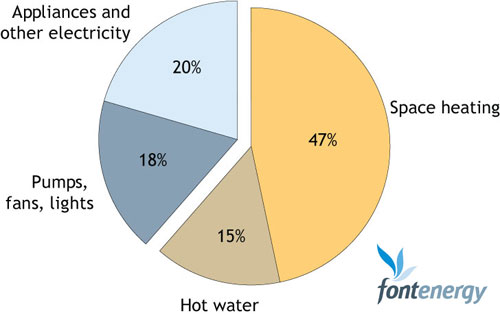
The pie chart above shows that of the emissions from houses in 2050, almost 2/3 will come from heat. Electricity, on the other hand, will only make up just over a third of emissions. Without radical action to decarbonise heat, we won’t get anywhere near the 2050 target.
zcc III: onsite, offsite, and the role of private wires
Posted in biomass, chp, Code for Sustainable Homes, energy, engineering, private wire, renewable energy, SAP, sustainability, wind turbines, zero carbon, tagged zero carbon consultation on January 8, 2009| 2 Comments »
From the zero carbon consultation, you can see that CLG has accepted that we need to resolve the onsite / offsite question. They have also moved away from the requirement for private wire networks or “direct connections” between generators and homes since it caused all sorts of problems.
So positive moves from CLG, but there is still a huge amount of confusion over what onsite and offsite actually mean. This is a crucial issue since only onsite energy will count towards carbon compliance, while offsite energy is only likely to count as an allowable solution.
Christmas trees could supply energy to 25k zero carbon homes
Posted in agriculture, biofuel, biomass, chp, climate change, renewable energy, sustainability, tagged energy from Christmas trees on December 10, 2008| 3 Comments »
Just to warn you, this post is a bit trite and must have been done before, but here goes…
I reckon if you chipped all the Christmas trees in the UK and fed them into a biomass CHP , you’d provide enough zero carbon heat and electricity to supply about 25,000 new homes for the entire year.
If you can be bothered, here’s how I got there:
DH standards and customer heat charter on the way
Posted in chp, engineering, london, tagged CHPA, DH, district heating, LEP on December 4, 2008| Leave a Comment »
Made it in the paper this week.
Casey Cole of low carbon consultant, Fontenergy, said the unregulated nature of heat has led to some “questionable practices” and needed outside regulation: “Both a technical standard for heat networks and a customer charter for heat are very welcome developments and we’ll be helping LEP with their work alongside the CHPA.
“While many buildings in London are now “district heat ready”, to date there’s been no common standard to ensure these schemes are actually able to connect to each other. In addition, rules for the provision of heat will give greater protection to customers and hopefully unify the many disparate methodologies in use at the moment.”
feed in tariffs – what just happened?
Posted in chp, climate change, energy, feed in tariff, micro chp, renewable energy, sustainability, wind turbines, tagged Ed Miliband, Energy Bill, Lord Hunt of Kings Heath, Lord Whitty on October 23, 2008| 2 Comments »
Away from the fanfare around Ed Miliband’s announcement that a feed in tariff (FiT) is on the way, the Lords have been debating an amendment to the Energy Bill that has the support of Conservatives, Lib Dems, and even some Labour peers.
What’s in the amendment? It says the Secretary of State has one year from the passing of the bill to bring in a feed in tariff. And the qualifying technologies, their maximum capacity, and their level of support are left to the Secretary of State to decide with no specified cap.
Despite wide support, it was clear that the Government wouldn’t officially get behind the bill as it wasn’t their idea. In fact, as recently as June the Government were firmly against a feed in tariff.
Baroness Wilcox, the amendment’s sponsor, has now withdrawn it, but only on the condition that the Government meet specific terms in their own amendment, which they’re expected put forward on 5 November. However, if the Government doesn’t fulfill her demands, she will reintroduce her original amendment. Here are her terms in a nutshell (my comments in italics):
-
Join 1,209 other subscribers
categories
Recent Comments
Why Ofgem must stick… on how many old homes will get he… Marko Cosic on Testing, testing Martin Winlow on the myth of stone walls as… Martin Winlow on the myth of stone walls as… Martin Winlow on the myth of stone walls as… AlanDHill@hotmail.co… on the myth of stone walls as… Comment: What would… on why we’ll share Open… Top Posts
archive
- May 2024
- January 2019
- August 2018
- October 2017
- July 2017
- March 2017
- January 2017
- November 2016
- October 2016
- September 2016
- July 2016
- May 2016
- April 2016
- March 2016
- February 2016
- January 2016
- October 2015
- August 2015
- June 2015
- April 2015
- March 2015
- January 2015
- December 2014
- November 2014
- October 2014
- September 2014
- June 2014
- May 2014
- April 2014
- March 2014
- January 2014
- December 2013
- November 2013
- October 2013
- February 2013
- January 2013
- July 2012
- June 2012
- May 2012
- April 2012
- March 2012
- June 2011
- January 2011
- October 2010
- August 2010
- June 2010
- April 2010
- March 2010
- February 2010
- January 2010
- October 2009
- September 2009
- August 2009
- July 2009
- June 2009
- May 2009
- April 2009
- March 2009
- February 2009
- January 2009
- December 2008
- November 2008
- October 2008
- September 2008
- August 2008
- July 2008
- June 2008
- May 2008
- April 2008
- March 2008
- February 2008
- January 2008
- November 2007
- October 2007
- September 2007
- August 2007
- July 2007
- June 2007
- May 2007
- April 2007
- March 2007
- February 2007
- January 2007


 carbon limited