Feeds:
Posts
Comments

Archive for the ‘climate change’ Category

I just received a very interesting comment from a “simple builder” about the regulatory maze. There are some interesting points in there. I don’t agree with all of them but I wanted to draw attention to them just the same:

Sorry guys I just have to speak out.

I speak as a simple Builder, we are a practical breed, not scientists, but we are being treated with rafts of legislation written by lunatics…

(more…)

Read Full Post »

A bunch of green bloggers got together last week after EcoBuild and as the pints slid down, the conversation got increasingly nerdtastic. It got so bad that drunken consultants were pulling out their laptops (never a good idea in the pub) and gesturing wildly at powerpoint slides as they slurred and babbled incoherently. Not naming names, but we know who we are.

Inevitably,  the conversation turned to feed in tariffs in the UK. In December, the wind turbine company Proven Energy called for a 40p rate. The folks at quietrevolution have suggested 25p for the first 25MWh, then stepping down. Turning to PV, a survey for solarcentury found that 90% of people would “consider” solar with a FiT of 50p.

There’s no doubt that the FiT in Germany is responsible for the PV boom there, creating 250k jobs. Other countries such as Spain, Italy, Greece, France, Netherlands, Spain, Portugal, and Bulgaria (Bulgaria?! We’ve been shown up by Bulgaria?) have followed suit.

So what would level of FiT would be required in the UK to match the support shown by a country like, say, Italy?

(more…)

Read Full Post »
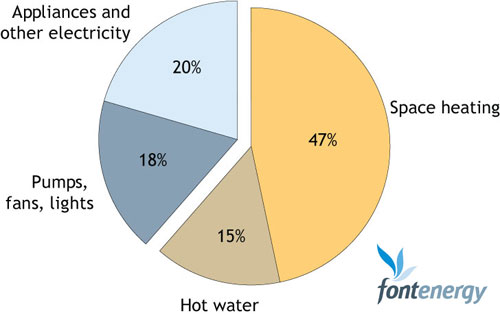
In the last post, I argued that we’ve got to strip the carbon out of almost all of our existing stock in order to hit the 2050 target. That’s a huge challenge. Phil Clark summed it up in a comment:

I would consider it a near impossibility to upgrade every old leaky house without some massively radical action.

I completely agree: it’s going to take radical action. But what kind? The picture gets a bit clearer if you take a look at where the carbon is coming from.

Looking at the graph from my previous post, we can take a snapshot of where the emissions will come from in 2050 under a business-as-usual scenario.

carbon-from-houses-by-end-use-in-2050

The pie chart above shows that of the emissions from houses in 2050, almost 2/3 will come from heat. Electricity, on the other hand, will only make up just over a third of emissions. Without radical action to decarbonise heat, we won’t get anywhere near the 2050 target.

(more…)

Read Full Post »

Sounds crazy but it’s true.

Here’s a graph I put together showing the number of houses of various ages up to 2050. It clearly shows that, using current demolition rates, the vast majority of the homes in use in 2050 have already been built. Details on how I put the graph together can be found in a previous post.

(more…)

Read Full Post »

CLG drop quite a few hints in the zero carbon consultation that they’re prepared to set the carbon compliance requirement at 70%. In other words, new schemes would have to achieve a reduction of 70% in regulated emissions relative to 2006 regulations. But if you look a little closer, it soon becomes clear that this figure isn’t what it seems.

(more…)

Read Full Post »

Just under the wire! The CLG has published the consultation on zero carbon. Big hat tip to Mr Devlin. Comments to follow shortly.

Read Full Post »

Just to warn you, this post is a bit trite and must have been done before, but here goes…

I reckon if you chipped all the Christmas trees in the UK and fed them into a biomass CHP , you’d provide enough zero carbon heat and electricity to supply about 25,000 new homes for the entire year.

If you can be bothered, here’s how I got there:

(more…)

Read Full Post »

At the end of last week, I was happy to hear that Jonathon Porritt had joined the board at Wilmott Dixon. It’s particularly poignant timing, given the beating the industry has taken in recent months: Wilmott Dixon is underlining their commitment to achieving the carbon reductions that will be required in the built environment in the runup to 2016 and beyond.

Ok, you could argue that he’s only going to be a non-executive director, so his influence will be limited to board level. That might not sound like such a bad thing, but working with a couple of developers of similar size,  I’ve been surprised to find genuine support for low carbon measures among the board only to run into a brick wall at operational level. One is no good without the other. But in WD’s case, let’s assume that vision is going to translate into action.

The point is, Wilmott Dixon have made this move at a time of low morale and deep skepticism in the construction industry. Many developers find themselves saddled with projects whose land values were agreed at the height of the property boom. In some cases, even where there’s a solid case for development, the banks refuse to offer credit. The zero carbon housing deadline in 2016 is looming and we haven’t even decided yet what “zero carbon” means or how it should be achieved. Who can blame developers who’ve sunk into a funk and dismiss those who talk about zero carbon as having their heads in the clouds?

(more…)

Read Full Post »

The mighty triumvirate has received royal assent: the climate change bill (excellent), the energy bill (excellent), and the planning bill (frightening) have now become acts. So now the UK is legally bound to reduce emissions by 80% by 2050 with interim targets along the way. Within a year we’ll see feed in tariffs for distributed energy up to 5MW. And ironically, the planning bill may be used to railroad through airport expansion and new coal fired power – but let’s ignore that for now.

(more…)

Read Full Post »

Over on the Sustainability Blog, Michael pointed out that, according to the IEA report, the cost of decarbonising the world’s energy supply would be less than has been spent recently in shoring up the world’s economies. For me a slightly more disturbing number is hidden deeper in the IEA report.

$3.6 trillion – the cost of decarbonising all the world’s energy production between 2010 and 2030.

$9.5 trillion – required investment into oil infrastructure in order to meet demands for oil between now and 2030.

So the cost of decarbonising is a fraction of the amount needed in order to shore up oil infrastructure to maintain business as usual. Sure, this is an oversimplification, but at the heart of it is a sad truth.

Read Full Post »

« Newer Posts - Older Posts »

Design a site like this with WordPress.com
Get started