Feeds:
Posts
Comments

Archive for the ‘energy’ Category

Sometimes a tweet just won’t do. Yesterday I tweeted this:

DECC cnsltn out on gas gen. Um, 25% of UK elec gen lost by 2020. 20 yrs to new nuclear. No coherent RE strat. #DoneDeal #Fracking #3Degrees

…but somehow it doesn’t immediately convey the whole point. So here’s an expanded version:

DECC has today published its call for evidence  to “to inform a gas generation strategy to deliver a secure and affordable route to a low carbon economy.”
It’s lovely of them to ask. But consider the backdrop to this consultation:

  • Between a quarter and a third of current UK electricity generation capacity will come offline by the end of the decade. (It’s worth reading that sentence again – the implications are massive.)
  • New nuclear will not fill the gap. It will take at least 8 years to build each new nuclear power station and the stable of new UK nukes is struggling get out of the gates – that 8 year clock hasn’t even started ticking. In a massive setback to new nuclear, last month RWE and Npower abandoned plans for two new power stations in the wake of the collapse of the German nuclear market.
  • Without a radical change in policy, Renewables and energy storage will not grow at a sufficient rate to fill the gap.

So what does that leave us?

(more…)

Read Full Post »

Sure, biodiesel is considered “renewable” in the upcoming building regs. But that won’t stop the backlash against developers who use it.

Yesterday a biodiesel generation plant proposed for Avonmouth near Bristol was rejected 6-2 in planning committee on the grounds of its  impact on rainforests on the other side of the globe. Of the 1,121 letters received by councilors in advance of the meeting, only 2 were in favour of the plant.

Strictly speaking, the application should not have been rejected. The plant passed air quality tests and all other material considerations.  The chairwoman of the committe went as far as saying she could find no reason to refuse the application and the city’s legal chief agreed. After all, it’s not the job of the planners to consider the source of fuel – that’s OFGEM’s role.

But that didn’t stop the committee throwing it out anyway, at the end of a fiery meeting, on moral and ethical grounds.

(more…)

Read Full Post »

In Whitehall, advocates of PAYS and an expanded suppliers obligation are clashing over which mechanism should be used to refurb existing housing. This is the second post of two. If you missed it, read the first part here.

Here’s a quick summary of the two mechanisms:

(more…)

Read Full Post »

Hitting the 80% carbon reduction by 2050 has huge implications (and costs) for the residential sector. Two strategies are emerging for dealing with these costs, each with its own potentially severe side effects.

(more…)

Read Full Post »

DECC have announced the final FiT levels in advance of the incentive coming in in April. Having had a number of disheartening conversations with policy makers over the last few months, the FiT levels are no surprise. No one in government seemed to mind that the FiT would be a subsidy for middle class greenies and folks like McAlpines. The important thing was that the FiT wouldn’t cost too much.

(more…)

Read Full Post »

I’m on the train through Surrey on my way into London and there is still a thick blanket of snow on the ground. But not necessarily on the roofs: some are covered and some are bare. Occasionally the rows of terraced houses alternate like squares on a chess board. And it all depends on heat loss.

It’s funny catching such a stark glimpse of something that is ordinarily invisible. Heat, and therefore money, from these homes is gushing out through the roof. Ordinarily the symptoms only appear on a monthly bill where they’re too abstract and unlikely to have any effect at all. What do you suppose would happen if people could see a bit further up the red end of the spectrum and looked at their own houses on a chilly morning?

Read Full Post »

Wrong. Unless they include extra charges.

The Code for Sustainable Homes, upcoming changes to building regs, and national emissions targets are all driving the industry towards much wider use of on-site generation.

Reducing carbon with on-site generation (also called “distributed energy” or just “DE”) brings extra costs relative to the business-as-usual approach of individual gas boilers and grid electricity. Cyril Sweett and others put the additional cost of building a zero-regulated-emissions house at £10k – £13k per dwelling, and some recent projects at work have borne this out.

This £10k – £13k is a massive problem for developers and housing associations, in some cases making projects infeasible.

There’s a widespread misconception that ESCOs can make the problem disappear. Some of this misconception has been fostered by ESCOs  keen to get deals on the books (I’ll come back to this in a minute), but I think most of the problem is down to a poor understanding of distributed energy and how ESCOs make money.

So how much capital cost can ESCOs take on? Here’s an example: (more…)

Read Full Post »

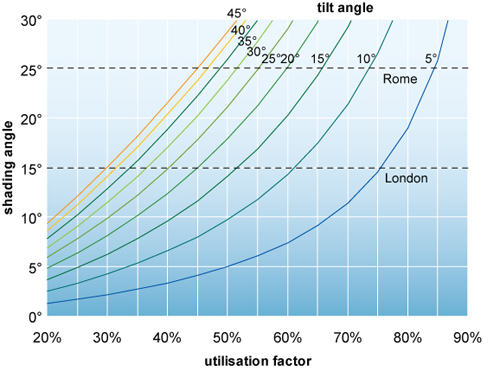
Following on from discussion about planning reports last week, here’s a chart I put together showing roughly how much PV you can fit on a flat roof. It’s based on the formulas described by Volker Quaschning, the German Godfather of Sol (Thank you! I’ll be here all week. Try the crab).

Solar-shading

The shading angle is the angle from the bottom of the panel behind to the top of the panel in front. As a rule of thumb, you can use the height of the sun at noon on the winter solstice – for London, this is about 15°. Utilisation factor is the ratio of panel area to roof area.

(more…)

Read Full Post »

For consultants, energy reports for planning are fantastic: a bit of SAP, a few benchmarks, some spreadsheet magic, and hey presto you’re sending an invoice. But the contents of the energy report can have huge implications, in some cases committing the scheme to commercially or legally impossible strategies, causing delays and increasing costs later in the programme. Here are a couple of examples:

(more…)

Read Full Post »

Government launched a barrage of documents at us yesterday. I was mostly watching out for the Renewable Strategy but that was only a small part of it. Here’s the reading roundup:

  • UK Low Carbon Transition Plan – this is the overarching doc. It’s basically the roadmap to meeting the legally binding carbon budgets from now to 2050 with some good stuff on how it will be done. But puts a hell of a lot of faith in nuclear, building new coal (with mythical magical CCS), and the efficacy of the EU ETS. 7m homes to get refurbed under Pay as You Save (more on this later). Cars to emit less carbon.
  • Consultation on Renewable and Small Scale Low Carbon Electricity Financial Incentives – the consultation on the RO and the Feed in Tariff. They appear to have watered down the FiT saying 5% return is enough to attract investment. We’ve got to stop the government from nickel and diming its way into grand sounding but useless gestures.
  • Renewable Energy Strategy – Following the draft version in 2008, this doc lays out the map for the UK to meet 15% of its total energy requirements from renewables by 2020 (this in an EU requirement as opposed to the other targets with are internal). A good thing: renewables claiming FiT’s are also likely to count towards Zero Carbon standard.
  • Low Carbon Industrial Strategy – much of the above recycled but in the context of UK business. How jobs will be created and the costs of transitioning to a low carbon economy will be minimised. It might have been the picture of Peter Mandelson in the intro, but I struggled to maintain any enthusiasm reading this one. Tidal power to get £60m. Nuclear to get a £15m research centre (let the subsidies begin!), the SW of England to become a pilot low carbon economic area.

Read Full Post »

« Newer Posts - Older Posts »

Design a site like this with WordPress.com
Get started