Feeds:
Posts
Comments

Archive for the ‘engineering’ Category

In January I wrote a post about the fact that, contrary to expectations, no meters will be retrofitted under the new Heat Network Regulations. This is because the assumptions in DECC’s meter viability tool mean almost no install will pass the financial viability test.

After hitting publish on that post, things moved pretty fast.

(more…)

Read Full Post »

…or “How to end dogma-driven design”

money

Building design professionals are often driven by theories and ideology rather than facts. But whether we’re talking about heat networks or air-tightness, photovoltaics or passive ventilation, design decisions should be based on data, not dogma. It’s time to stop arguing, start measuring and learn from the results.

(more…)

Read Full Post »

Sonderby

Heat network at Sønderby – images from linked design guide


When writing a recent post about the low temperature DH network at Lystrup, I contacted the author of the related technical report, Jan Thorsen. In Jan’s response he kindly included a copy of Guidelines for Low-Temperature District Heating (PDF).

This guide is essential reading for designers and operators of DH systems. It shows how DH with flow temperatures of around 55 and return temps of around 25 (also called “fourth generation” or “4GDH”) can be used to serve high efficiency homes as well as buildings on low heat density networks.

At this point you might say, hang on a minute – what are we doing considering 4GDH when we struggle to deliver decent 3rd generation (70/40) networks in the UK? And I’d say you’ve got a point. In fact, I spent a depressingly large chunk of last week trying to help salvage the efficiency of another new network that is horrendously oversized and was probably doomed to low efficiency before it even left the drawing board. So I’m sympathetic with the view that UK engineers need to get our houses in order before moving onto the cutting edge stuff.

But looking ahead to the strategies employed in more advanced, lower temperature systems helps to highlight the design principles that we should be focusing on, even on today’s projects in the UK.

(more…)

Read Full Post »

Highly efficient homes on Lystrup Network – img from linked report

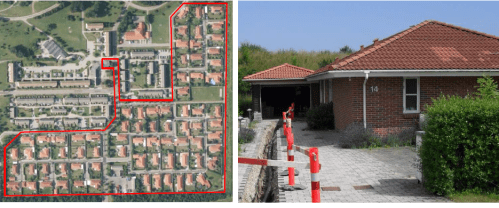
I was recently given a copy of this fascinating report describing a 2-year study of a district heat network serving 40 highly efficient homes.

Using district heat in this way flies in the face of the prevailing view in the UK, which is that DH is incompatible with low energy housing. In this country we assume that low heat demand in homes means that heat losses from the network will always outweigh useful heat delivered.

But as you’ll see in this post, this view isn’t correct. The Lystrup Danish network serving near-Passivhaus-standard terraced homes has just 17% losses. Achieving this required a very low temperature heat network as well as careful design, commissioning and monitoring of the resulting system.

For engineers and district heat geeks, the report is packed with fabulous nuggets of information, the most interesting of which I’ve pulled out in the following post. If you’re not a DH geek, I imagine you’ve already stopped reading and are now watching Strictly.

Still here? Strap in and let’s GEEK OUT!

(more…)

Read Full Post »

I’ve done a blog post for the CHPA in the run up to the Heat 2014 conference on 5 November. Here’s the intro and link:

Metering and billing (M&B) is often seen as a necessary but rather dull cog in the district heating machine. For many heat network operators, heat metering is nothing more than a tool for ensuring customers are billed for the heat they consume. But it’s far more important than that. Heat metering can be used to monitor network efficiency, which can spell life or death for district heating schemes. Unfortunately, getting this performance data out of heat meters isn’t always easy…

Read the rest here.

Read Full Post »

Octavia_Elizabeth_House_WembleyWe’re using our Guru smart metering and control platform to do real-time monitoring of district heating at Octavia’s flagship site in NW London. Our aim is to eliminate the two biggest risks that DH operators face: bad debt and hidden inefficiencies. Here’s an article summarising what we’re up to.

Want to stay updated? Subscribe to email alerts for this blog or follow me on twitter.

Read Full Post »

Picture3

This is number 7 in a series on district heating. Here’s where to find  1, 2, 3, 4, 5 and 6.

Your district heating network might be perfectly designed, but if it’s not installed and commissioned right it is doomed to fail, potentially costing you and your tenants a huge amount of money. In this post, we’ll talk about how to get DH install and commissioning right.

(more…)

Read Full Post »

This is the sixth post in a series on district heating. Here’s where to find  1, 2, 3, 4 and 5.

We’ve looked at how district heating (DH) can go wrong. Now let’s look at ways to help make sure it goes right. First: design.

(more…)

Read Full Post »

This is the fifth post in a series on district heating. Here’s where to find  1, 2, 3 and 4.

So far we’ve looked at how poor design, installation or commissioning can doom a DH network to poor efficiency. In this post, I’ll briefly outline why it’s important to monitor and look after a DH network throughout its life, and what can go wrong if you don’t.

Most DH systems are commissioned and then ignored. It may be many months or even several years before anyone revisits the scheme to look closely at how it’s operating, usually prompted by something going badly wrong. The first casualty of network neglect is efficiency.

(more…)

Read Full Post »

All those bare components add up!

All those bare components add up

This is the fourth post in the series. If you haven’t yet, check out the first, second and third posts first.

Poor installation and commissioning can bring even the best designed network to its knees. In this post, I’ll look at some of the ways these crucial phases go wrong. First, installation:

(more…)

Read Full Post »

« Newer Posts - Older Posts »

Design a site like this with WordPress.com
Get started