Feeds:
Posts
Comments

Archive for the ‘engineering’ Category

This is number 3 in a series on DH. Here’s where to find the first and second posts.

A key way district heating networks go wrong is through poor design. This can come from:

  1. a lack of good engineering
  2. a lack of relevant standards and guidance
  3. a perverse incentive for engineers to be overly conservative in order to protect their PI insurance
  4. clients not knowing what to ask for from their contractors

In this post, I’ll take a closer look at these problems.

(more…)

Read Full Post »

This is the second post in a series on DH. The first can be found here.

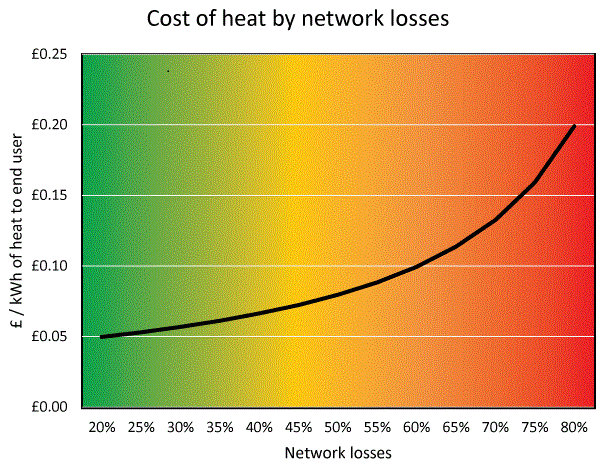
As I mentioned in my previous post, cost of heat on DH schemes is directly tied to system efficiency. The more efficient the system, the less fuel is needed to meet the heat requirements of the customers. And of course the reverse is also true: lower efficiency means higher cost of heat. This relationship between efficiency and cost is hugely important: it’s real cash, coming from residents to pay their heating bills and from the landlord or ESCO to pay the fuel bill.

In fact, I’d go as far as saying that efficiency is the single most important issue for DH schemes. This post explains why efficiency matters so much.

heat-price-by-losses1

(more…)

Read Full Post »

District heating (DH) has become a common strategy for new developments to reduce carbon in order to satisfy planners and meet building regs. But despite its prevalence, in the UK we frequently get district heating wrong.

Most of what we do at work relates to DH in one way or another. At Insite we provide meter reading and customer care to several thousand people on district heating schemes. We take residents’ calls, help clients set tariffs and assess efficiency data, among other things. At Fontenergy (one of Insite’s two parent companies) we’ve project managed the design and install of DH networks and we operate centralised plant for ourselves and others. In our efforts to get DH right, we once even imported one of the best DH contractors from Denmark and worked with them to install a network in North London.

When it’s done right, DH is a cost-effective strategy for delivering low carbon heat. What’s more, it’s an essential technology for decarbonising heat in the UK (mainly because relying entirely on the theoretical decarbonisation of the grid in order to electrify heat is nuts, but that’s another post). The reality is we need DH, but often we don’t do it right.

(more…)

Read Full Post »
I was at a conference last week on smart metering in Cambridge. A guy from Anglian water reminded us all that the water network in England and Wales loses 3.36Bn litres of water each day due to leaks. That sounds like a lot – is it?

If the average person in the UK uses 150 litres per day, that means we’re losing enough clean, pure water for 22.4 million people every day. There’s only 56m people in England and Wales, so that’s enough water for around 40% of the population!

I’m stunned.

Read Full Post »

Sure, biodiesel is considered “renewable” in the upcoming building regs. But that won’t stop the backlash against developers who use it.

Yesterday a biodiesel generation plant proposed for Avonmouth near Bristol was rejected 6-2 in planning committee on the grounds of its  impact on rainforests on the other side of the globe. Of the 1,121 letters received by councilors in advance of the meeting, only 2 were in favour of the plant.

Strictly speaking, the application should not have been rejected. The plant passed air quality tests and all other material considerations.  The chairwoman of the committe went as far as saying she could find no reason to refuse the application and the city’s legal chief agreed. After all, it’s not the job of the planners to consider the source of fuel – that’s OFGEM’s role.

But that didn’t stop the committee throwing it out anyway, at the end of a fiery meeting, on moral and ethical grounds.

(more…)

Read Full Post »

In Whitehall, advocates of PAYS and an expanded suppliers obligation are clashing over which mechanism should be used to refurb existing housing. This is the second post of two. If you missed it, read the first part here.

Here’s a quick summary of the two mechanisms:

(more…)

Read Full Post »

Hitting the 80% carbon reduction by 2050 has huge implications (and costs) for the residential sector. Two strategies are emerging for dealing with these costs, each with its own potentially severe side effects.

(more…)

Read Full Post »

DECC have announced the final FiT levels in advance of the incentive coming in in April. Having had a number of disheartening conversations with policy makers over the last few months, the FiT levels are no surprise. No one in government seemed to mind that the FiT would be a subsidy for middle class greenies and folks like McAlpines. The important thing was that the FiT wouldn’t cost too much.

(more…)

Read Full Post »

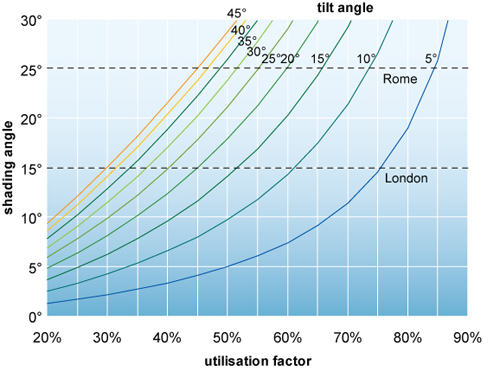
Following on from discussion about planning reports last week, here’s a chart I put together showing roughly how much PV you can fit on a flat roof. It’s based on the formulas described by Volker Quaschning, the German Godfather of Sol (Thank you! I’ll be here all week. Try the crab).

Solar-shading

The shading angle is the angle from the bottom of the panel behind to the top of the panel in front. As a rule of thumb, you can use the height of the sun at noon on the winter solstice – for London, this is about 15°. Utilisation factor is the ratio of panel area to roof area.

(more…)

Read Full Post »

For consultants, energy reports for planning are fantastic: a bit of SAP, a few benchmarks, some spreadsheet magic, and hey presto you’re sending an invoice. But the contents of the energy report can have huge implications, in some cases committing the scheme to commercially or legally impossible strategies, causing delays and increasing costs later in the programme. Here are a couple of examples:

(more…)

Read Full Post »

« Newer Posts - Older Posts »

Design a site like this with WordPress.com
Get started