Feeds:
Posts
Comments

Archive for the ‘renewable energy’ Category

Infuriatingly, it looks like the government may mothball the Environmental Performance Standard, which would have limited emissions from new large power stations. This is despite the fact that both the Conservatives and Libdems championed the policy while in opposition.

As a result it’s likely that emissions from grid electricity will stay high for quite some time. In fact the official line is that the carbon intensity of the grid will remain roughly steady until 2015, when it will plummet towards near-zero carbon in 2040. (As an aside, is it a coincidence that the dropoff comes in 2015, given that it’s the latest possible date for the next general election?) It will be interesting to see how that drop off moves in coming years.

The announcement strongly reinforces the message from DECC that decarbonisation of heat will not be achieved through electrification. In other words, heat pumps are not the answer to decarbonising heat at the national scale.

Source is table 1 from the recently published DECC stats.

Read Full Post »

It’s taken longer than I’d hoped, but here we go:

(more…)

Read Full Post »

In the UK we generate enough heat each year to meet the needs of every home in the country… and then we throw the heat away. So why should we promote the use of precious resources and expensive technologies to generate that heat a second time?

(more…)

Read Full Post »

The proper way to slash carbon emissions is to tax carbon at the point of fuel extraction and let the market sort the problem out.

But because there’s no political appetite for carbon tax, we end up tinkering at the margins trying to address the emissions problem in tortuous and esoteric ways. Here’s a list I jotted down on the train on my way into the office:

  • CERT
  • SHESP
  • CESP
  • PAYS
  • Decent Homes
  • Allowable Solutions
  • Part L
  • RHI
  • FiT
  • CCL
  • CRC
  • ROCs
  • Retrofit for the Future
  • JESSICA, JASPERS, ELENA
  • Expanded Suppliers Obligation

All of this cost and bureaucracy becomes redundant the moment the real price of carbon is reflected in the cost of energy. Is political expediency the biggest obstacle to carbon abatement?

Read Full Post »

Sure, biodiesel is considered “renewable” in the upcoming building regs. But that won’t stop the backlash against developers who use it.

Yesterday a biodiesel generation plant proposed for Avonmouth near Bristol was rejected 6-2 in planning committee on the grounds of its  impact on rainforests on the other side of the globe. Of the 1,121 letters received by councilors in advance of the meeting, only 2 were in favour of the plant.

Strictly speaking, the application should not have been rejected. The plant passed air quality tests and all other material considerations.  The chairwoman of the committe went as far as saying she could find no reason to refuse the application and the city’s legal chief agreed. After all, it’s not the job of the planners to consider the source of fuel – that’s OFGEM’s role.

But that didn’t stop the committee throwing it out anyway, at the end of a fiery meeting, on moral and ethical grounds.

(more…)

Read Full Post »

In Whitehall, advocates of PAYS and an expanded suppliers obligation are clashing over which mechanism should be used to refurb existing housing. This is the second post of two. If you missed it, read the first part here.

Here’s a quick summary of the two mechanisms:

(more…)

Read Full Post »

Hitting the 80% carbon reduction by 2050 has huge implications (and costs) for the residential sector. Two strategies are emerging for dealing with these costs, each with its own potentially severe side effects.

(more…)

Read Full Post »

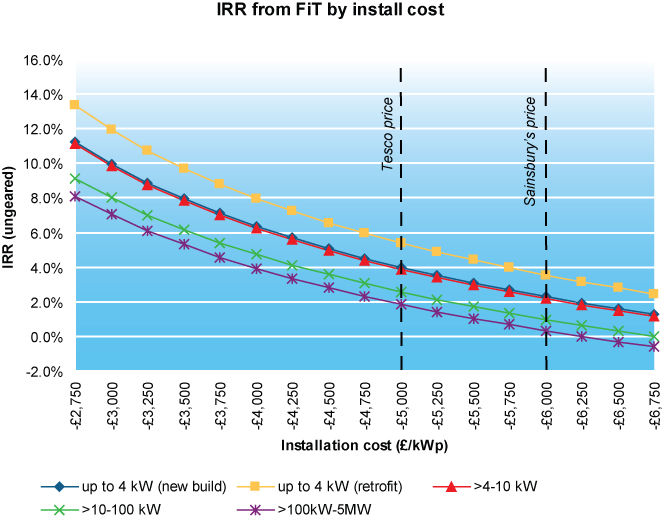
DECC have announced the final FiT levels in advance of the incentive coming in in April. Having had a number of disheartening conversations with policy makers over the last few months, the FiT levels are no surprise. No one in government seemed to mind that the FiT would be a subsidy for middle class greenies and folks like McAlpines. The important thing was that the FiT wouldn’t cost too much.

(more…)

Read Full Post »

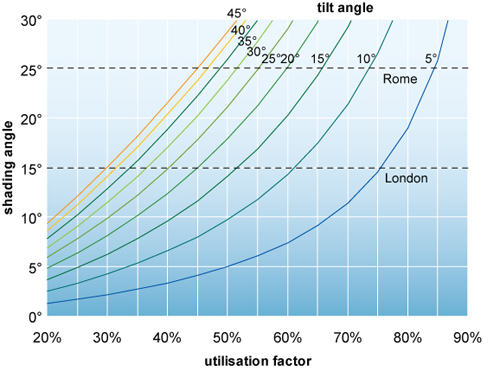
Following on from discussion about planning reports last week, here’s a chart I put together showing roughly how much PV you can fit on a flat roof. It’s based on the formulas described by Volker Quaschning, the German Godfather of Sol (Thank you! I’ll be here all week. Try the crab).

Solar-shading

The shading angle is the angle from the bottom of the panel behind to the top of the panel in front. As a rule of thumb, you can use the height of the sun at noon on the winter solstice – for London, this is about 15°. Utilisation factor is the ratio of panel area to roof area.

(more…)

Read Full Post »

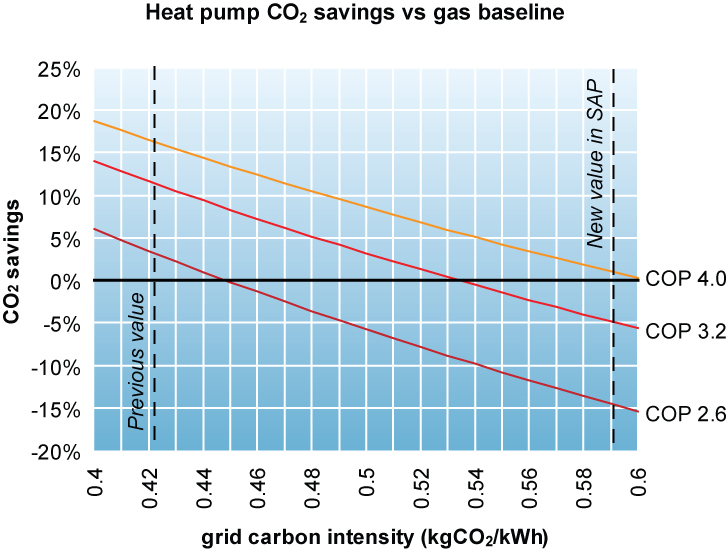
The new SAP has a revised carbon intensity for grid electricity (set in the consultation at 0.591 kgCO2/kWh, up from 0.422). This has a big impact on the resulting carbon emissions from heat pumps, in most cases making them higher than emissions from the worst boiler you can legally install. This goes for both air source and ground source.

You can see from the graph above that at a grid carbon intensity of 0.591 even a GSHP with a COP of 4 is struggling to outperform an 86% efficient gas boiler. The real world COPs seen at Barratt’s Chorley scheme (2.6 for GSHP) and recent field trials by Mitsubishi  (3.0 – 3.4 for ASHP according to a letter from Mitsubishi in the latest CIBSE mag) mean that heat pumps would emit significantly more carbon than the boiler.

And yet in the low carbon transition strategy, DECC state that heat pumps will be eligible for the Renewable Heat Incentive (pdf – see para 1.22), rewarding them for being a renewable energy source! What the hell are they thinking?

Here’s how I did the numbers:

(more…)

Read Full Post »

« Newer Posts - Older Posts »

Design a site like this with WordPress.com
Get started