Feeds:
Posts
Comments

Archive for the ‘sustainability’ Category

In Whitehall, advocates of PAYS and an expanded suppliers obligation are clashing over which mechanism should be used to refurb existing housing. This is the second post of two. If you missed it, read the first part here.

Here’s a quick summary of the two mechanisms:

(more…)

Read Full Post »

Hitting the 80% carbon reduction by 2050 has huge implications (and costs) for the residential sector. Two strategies are emerging for dealing with these costs, each with its own potentially severe side effects.

(more…)

Read Full Post »

Wrong. Unless they include extra charges.

The Code for Sustainable Homes, upcoming changes to building regs, and national emissions targets are all driving the industry towards much wider use of on-site generation.

Reducing carbon with on-site generation (also called “distributed energy” or just “DE”) brings extra costs relative to the business-as-usual approach of individual gas boilers and grid electricity. Cyril Sweett and others put the additional cost of building a zero-regulated-emissions house at £10k – £13k per dwelling, and some recent projects at work have borne this out.

This £10k – £13k is a massive problem for developers and housing associations, in some cases making projects infeasible.

There’s a widespread misconception that ESCOs can make the problem disappear. Some of this misconception has been fostered by ESCOs  keen to get deals on the books (I’ll come back to this in a minute), but I think most of the problem is down to a poor understanding of distributed energy and how ESCOs make money.

So how much capital cost can ESCOs take on? Here’s an example: (more…)

Read Full Post »
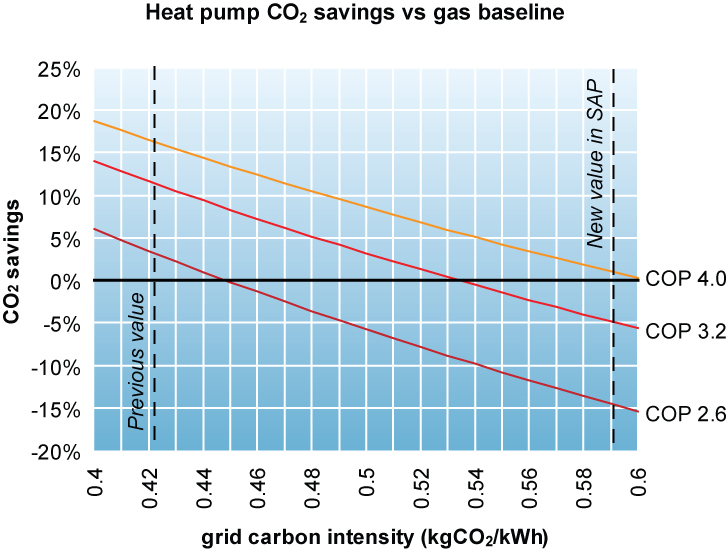
The new SAP has a revised carbon intensity for grid electricity (set in the consultation at 0.591 kgCO2/kWh, up from 0.422). This has a big impact on the resulting carbon emissions from heat pumps, in most cases making them higher than emissions from the worst boiler you can legally install. This goes for both air source and ground source.

You can see from the graph above that at a grid carbon intensity of 0.591 even a GSHP with a COP of 4 is struggling to outperform an 86% efficient gas boiler. The real world COPs seen at Barratt’s Chorley scheme (2.6 for GSHP) and recent field trials by Mitsubishi  (3.0 – 3.4 for ASHP according to a letter from Mitsubishi in the latest CIBSE mag) mean that heat pumps would emit significantly more carbon than the boiler.

And yet in the low carbon transition strategy, DECC state that heat pumps will be eligible for the Renewable Heat Incentive (pdf – see para 1.22), rewarding them for being a renewable energy source! What the hell are they thinking?

Here’s how I did the numbers:

(more…)

Read Full Post »

For consultants, energy reports for planning are fantastic: a bit of SAP, a few benchmarks, some spreadsheet magic, and hey presto you’re sending an invoice. But the contents of the energy report can have huge implications, in some cases committing the scheme to commercially or legally impossible strategies, causing delays and increasing costs later in the programme. Here are a couple of examples:

(more…)

Read Full Post »

Government launched a barrage of documents at us yesterday. I was mostly watching out for the Renewable Strategy but that was only a small part of it. Here’s the reading roundup:

  • UK Low Carbon Transition Plan – this is the overarching doc. It’s basically the roadmap to meeting the legally binding carbon budgets from now to 2050 with some good stuff on how it will be done. But puts a hell of a lot of faith in nuclear, building new coal (with mythical magical CCS), and the efficacy of the EU ETS. 7m homes to get refurbed under Pay as You Save (more on this later). Cars to emit less carbon.
  • Consultation on Renewable and Small Scale Low Carbon Electricity Financial Incentives – the consultation on the RO and the Feed in Tariff. They appear to have watered down the FiT saying 5% return is enough to attract investment. We’ve got to stop the government from nickel and diming its way into grand sounding but useless gestures.
  • Renewable Energy Strategy – Following the draft version in 2008, this doc lays out the map for the UK to meet 15% of its total energy requirements from renewables by 2020 (this in an EU requirement as opposed to the other targets with are internal). A good thing: renewables claiming FiT’s are also likely to count towards Zero Carbon standard.
  • Low Carbon Industrial Strategy – much of the above recycled but in the context of UK business. How jobs will be created and the costs of transitioning to a low carbon economy will be minimised. It might have been the picture of Peter Mandelson in the intro, but I struggled to maintain any enthusiasm reading this one. Tidal power to get £60m. Nuclear to get a £15m research centre (let the subsidies begin!), the SW of England to become a pilot low carbon economic area.

Read Full Post »

Good news. As spotted by Tom N, the LCBP Stream 2 is back up and running with £35m of new funds (and a hefty backlog of PV, GSHP, and solar thermal projects that weren’t processed before the money ran out the last time). One lovely feature: the cap for heat technology has gone from 45kW to 300kW. Much more sensible.

It’s clear this is the Government’s stopgap until the FiT comes in for electricity in March April2010  and the RHI comes in for heat generation in April 2011. They’ve put those dates on the LCBP website as if they were set in stone, but I wonder…

Read Full Post »

The Biomass Energy Centre has launched a national woodfuel supplier database. A couple of websites have tried to do this over the years but this one is already fairly well populated and it looks like BEC mean business.

Read Full Post »

Most people who work in the built environment agree that ESCO stands for Energy Services Company. But that seems to be the only thing about ESCOs that everyone agrees on – the term can mean vastly different things to different people.

So what is an ESCO?

The short answer is: there’s no one answer. Here’s a rough list of the services that an ESCO might offer. Keep in mind that a company might provide all, some, or only one of these services and still call themselves an ESCO:

ESCO-responsibilities

(more…)

Read Full Post »

We’ve all seen the private development sector hit the skids over the past nine months. At the moment, the only residential projects that seem to be going ahead are those with a large RSL component (and so grant-funded by the HCA). This has a serious implication from a regs point of view because from spring 2011 all publicly funded housing will have to meet Code 4 (pdf). That effectively means that the residential development sector, such as it is, has to meet its regulatory targets two years early.

Here’s a map (ok, I know Code 6 won’t look quite like that once the consultation finished, but it will still be a hell of a drop):

Regs-emissions-over-time-RSL2

Bob Cervi, the editor at the CIBSE Journal, writes this month that on the road to zero carbon “it’s going to be a quick six years.”

It’s going to be an even quicker 5.

Read Full Post »

« Newer Posts - Older Posts »

Design a site like this with WordPress.com
Get started