Feeds:
Posts
Comments

Archive for the ‘sustainability’ Category

I just listened to Nicholas Stern’s lecture at LSE on the train on the way home. It’s extremely interesting – have a listen if you haven’t already. Ricardo at XCO2e has posted a text summary here.

A couple of things that rubbed the wrong way:

  1. I find it odd when scientists, agencies, economists, etc base predictions on future population on current rates of growth – assuming 9 billion by 2050. It’s like a strange form of tunnel vision.
  2. While he described the hydrocardon economy as self-destructive, declining output didn’t seem to figure largely in his thinking
  3. How does he imagine we’ll feed such a population without fossil fuel derived fertiliser?
Read Full Post »

Recently faced with a consulting job that we couldn’t do in time at Fontenergy, I called Nick Devlin. Nick and I had done a lot of this particular type of work together at XCO2 and I knew he would do a great job.

Nick took on most of the burden. We collaborated online and by phone and within a week I delivered a superb report to the client. In fact it went so well that we’re now discussing formalising the arrangement and jointly developing some tools to allow us to carry out this type of work more efficiently, sharing the work and the profits.

So could small business networks be the future of low carbon consultancy?

(more…)

Read Full Post »

I just received a very interesting comment from a “simple builder” about the regulatory maze. There are some interesting points in there. I don’t agree with all of them but I wanted to draw attention to them just the same:

Sorry guys I just have to speak out.

I speak as a simple Builder, we are a practical breed, not scientists, but we are being treated with rafts of legislation written by lunatics…

(more…)

Read Full Post »

A bunch of green bloggers got together last week after EcoBuild and as the pints slid down, the conversation got increasingly nerdtastic. It got so bad that drunken consultants were pulling out their laptops (never a good idea in the pub) and gesturing wildly at powerpoint slides as they slurred and babbled incoherently. Not naming names, but we know who we are.

Inevitably,  the conversation turned to feed in tariffs in the UK. In December, the wind turbine company Proven Energy called for a 40p rate. The folks at quietrevolution have suggested 25p for the first 25MWh, then stepping down. Turning to PV, a survey for solarcentury found that 90% of people would “consider” solar with a FiT of 50p.

There’s no doubt that the FiT in Germany is responsible for the PV boom there, creating 250k jobs. Other countries such as Spain, Italy, Greece, France, Netherlands, Spain, Portugal, and Bulgaria (Bulgaria?! We’ve been shown up by Bulgaria?) have followed suit.

So what would level of FiT would be required in the UK to match the support shown by a country like, say, Italy?

(more…)

Read Full Post »

In the last post, I argued that we’ve got to strip the carbon out of almost all of our existing stock in order to hit the 2050 target. That’s a huge challenge. Phil Clark summed it up in a comment:

I would consider it a near impossibility to upgrade every old leaky house without some massively radical action.

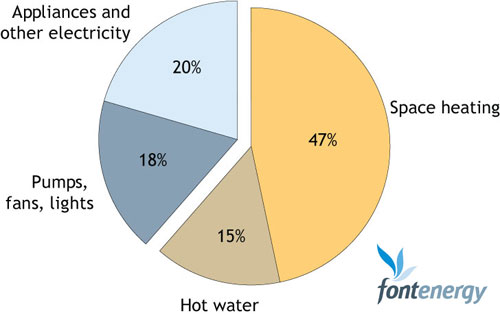
I completely agree: it’s going to take radical action. But what kind? The picture gets a bit clearer if you take a look at where the carbon is coming from.

Looking at the graph from my previous post, we can take a snapshot of where the emissions will come from in 2050 under a business-as-usual scenario.

carbon-from-houses-by-end-use-in-2050

The pie chart above shows that of the emissions from houses in 2050, almost 2/3 will come from heat. Electricity, on the other hand, will only make up just over a third of emissions. Without radical action to decarbonise heat, we won’t get anywhere near the 2050 target.

(more…)

Read Full Post »

Sounds crazy but it’s true.

Here’s a graph I put together showing the number of houses of various ages up to 2050. It clearly shows that, using current demolition rates, the vast majority of the homes in use in 2050 have already been built. Details on how I put the graph together can be found in a previous post.

(more…)

Read Full Post »

CLG drop quite a few hints in the zero carbon consultation that they’re prepared to set the carbon compliance requirement at 70%. In other words, new schemes would have to achieve a reduction of 70% in regulated emissions relative to 2006 regulations. But if you look a little closer, it soon becomes clear that this figure isn’t what it seems.

(more…)

Read Full Post »

From the zero carbon consultation, you can see that CLG has accepted that we need to resolve the onsite / offsite question. They have also moved away from the requirement for private wire networks or “direct connections” between generators and homes since it caused all sorts of problems.

So positive moves from CLG, but there is still a huge amount of confusion over what onsite and offsite actually mean. This is a crucial issue since only onsite energy will count towards carbon compliance, while offsite energy is only likely to count as an allowable solution.

(more…)

Read Full Post »

In case you don’t fancy wading through it, this is a brief summary of the zero carbon consultation doc. While nothing will be finalised until next summer (after they’ve ruminated over the responses), the document does give some insight into the way CLG is leaning on some issues.

At the core of the document is the government’s preferred framework for reaching zero carbon. In order of priority:

  1. A minimum standard of energy efficiency will be required.
  2. A minimum carbon reduction should be achieved through a combination of energy efficiency, onsite low and zero carbon (LZC) technologies, and directly connected heat. This is referred to as achieving carbon compliance.
  3. Any remaining emissions should be dealt with using allowable solutions, including offsite energy.

(more…)

Read Full Post »

Just under the wire! The CLG has published the consultation on zero carbon. Big hat tip to Mr Devlin. Comments to follow shortly.

Read Full Post »

« Newer Posts - Older Posts »

Design a site like this with WordPress.com
Get started