Hitting the 80% carbon reduction by 2050 has huge implications (and costs) for the residential sector. Two strategies are emerging for dealing with these costs, each with its own potentially severe side effects.
Archive for the ‘zero carbon’ Category
two roads to solving the refurb crisis – part 1
Posted in climate change, Code for Sustainable Homes, energy, engineering, ESCO, passivhaus, PAYS, renewable energy, sustainability, utilities, zero carbon, tagged CLG, DECC, HEMS, HESS, Supplier Obligation on February 14, 2010| 5 Comments »
low carbon development: ESCOs can take on all the extra cost, right?
Posted in Code for Sustainable Homes, energy, ESCO, feed in tariff, sustainability, utilities, zero carbon on October 7, 2009| 4 Comments »
Wrong. Unless they include extra charges.
The Code for Sustainable Homes, upcoming changes to building regs, and national emissions targets are all driving the industry towards much wider use of on-site generation.
Reducing carbon with on-site generation (also called “distributed energy” or just “DE”) brings extra costs relative to the business-as-usual approach of individual gas boilers and grid electricity. Cyril Sweett and others put the additional cost of building a zero-regulated-emissions house at £10k – £13k per dwelling, and some recent projects at work have borne this out.
This £10k – £13k is a massive problem for developers and housing associations, in some cases making projects infeasible.
There’s a widespread misconception that ESCOs can make the problem disappear. Some of this misconception has been fostered by ESCOs keen to get deals on the books (I’ll come back to this in a minute), but I think most of the problem is down to a poor understanding of distributed energy and how ESCOs make money.
So how much capital cost can ESCOs take on? Here’s an example: (more…)
PAYS for new build doesn’t feel quite right
Posted in PAYS, zero carbon, tagged UKGBC on September 9, 2009| 1 Comment »
Although PAYS has been conceived to address retrofit, developers and RSLs are hoping it might also reduce the financial burden of meeting more stringent upcoming regs for new build.
In theory it works like this: by capitalising future energy savings, developers could afford to put in the low carbon measures they need to in order to hit strict limits on emissions. The occupants then use a portion of the savings to pay off this capital lump.
Developers hit their targets and occupants get savings. Everyone’s a winner. But in the case of new build, what are the savings measured against? The UKGBC final PAYS report suggests that:
biodiesel to be recognised under building regs – but it’s no silver bullet for zero carbon
Posted in biofuel, chp, DER Calculation, zero carbon, tagged biodiesel, SAP on August 25, 2009| 1 Comment »
Biodiesel will almost certainly be a recognised fuel under to upcoming changes to building regs, opening the door to biodiesel CHP as a way to meet increasingly stringent limits on emissions. While a number of big urban developments will breathe a sigh of relief at the news, it’s not all plain sailing. (more…)
how much PV can you fit on a flat roof?
Posted in energy, engineering, feed in tariff, london, PV, renewable energy, zero carbon, tagged Volker Quaschning on August 14, 2009| Leave a Comment »
Following on from discussion about planning reports last week, here’s a chart I put together showing roughly how much PV you can fit on a flat roof. It’s based on the formulas described by Volker Quaschning, the German Godfather of Sol (Thank you! I’ll be here all week. Try the crab).
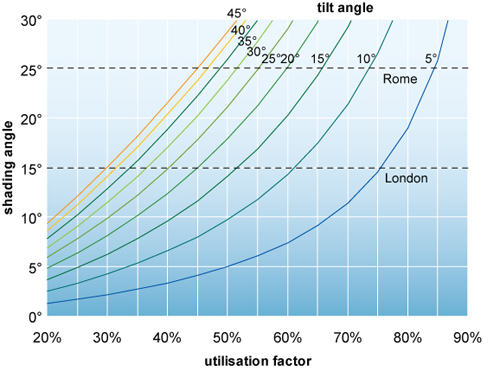
The shading angle is the angle from the bottom of the panel behind to the top of the panel in front. As a rule of thumb, you can use the height of the sun at noon on the winter solstice – for London, this is about 15°. Utilisation factor is the ratio of panel area to roof area.
planning reports may be ticking time bombs
Posted in biomass, chp, climate change, Code for Sustainable Homes, energy, engineering, london, private wire, renewable energy, SAP, sustainability, zero carbon, tagged Merton Rule on August 6, 2009| 1 Comment »
For consultants, energy reports for planning are fantastic: a bit of SAP, a few benchmarks, some spreadsheet magic, and hey presto you’re sending an invoice. But the contents of the energy report can have huge implications, in some cases committing the scheme to commercially or legally impossible strategies, causing delays and increasing costs later in the programme. Here are a couple of examples:
Sunday Times quote
Posted in climate change, Code for Sustainable Homes, other stuff, renewable energy, zero carbon on August 3, 2009| 2 Comments »
Made it into the Sunday Times this weekend in an article titled Ed Miliband’s carbon neutral homes pledge in peril.
Two things: first, I sometimes feel a little uneasy speaking to journalists because I might be selectively quoted – but I needn’t have worried. And second, it’s very interesting to see this sort of article making its way into the mainstream press. Discussion about low carbon is spreading outside the building industry.
back-pedalling CLG to set carbon compliance requirement at only 44%
Posted in Code for Sustainable Homes, SAP, zero carbon on July 21, 2009| 2 Comments »
I’ve written about this before but in light of the Low Carbon Transition Plan launched last week, it’s worth reiterating:
It’s increasingly clear that carbon reduction through on site measures will be set at 70% of regulated emissions. Sounds quite high. But in reality this equates to just 44% of total emissions – less than half of the reduction originally required under the Zero Carbon definition!
document mania – reading roundup
Posted in climate change, energy, feed in tariff, renewable energy, sustainability, zero carbon, tagged Ed Miliband, Lord Hunt, Low Carbon Industrial Strategy, Peter Mandelson, Renewable Energy Strategy, UK Low Carbon Transition Plan on July 16, 2009| 2 Comments »
Government launched a barrage of documents at us yesterday. I was mostly watching out for the Renewable Strategy but that was only a small part of it. Here’s the reading roundup:
- UK Low Carbon Transition Plan – this is the overarching doc. It’s basically the roadmap to meeting the legally binding carbon budgets from now to 2050 with some good stuff on how it will be done. But puts a hell of a lot of faith in nuclear, building new coal (with mythical magical CCS), and the efficacy of the EU ETS. 7m homes to get refurbed under Pay as You Save (more on this later). Cars to emit less carbon.
- Consultation on Renewable and Small Scale Low Carbon Electricity Financial Incentives – the consultation on the RO and the Feed in Tariff. They appear to have watered down the FiT saying 5% return is enough to attract investment. We’ve got to stop the government from nickel and diming its way into grand sounding but useless gestures.
- Renewable Energy Strategy – Following the draft version in 2008, this doc lays out the map for the UK to meet 15% of its total energy requirements from renewables by 2020 (this in an EU requirement as opposed to the other targets with are internal). A good thing: renewables claiming FiT’s are also likely to count towards Zero Carbon standard.
- Low Carbon Industrial Strategy – much of the above recycled but in the context of UK business. How jobs will be created and the costs of transitioning to a low carbon economy will be minimised. It might have been the picture of Peter Mandelson in the intro, but I struggled to maintain any enthusiasm reading this one. Tidal power to get £60m. Nuclear to get a £15m research centre (let the subsidies begin!), the SW of England to become a pilot low carbon economic area.
LCBP back up and running
Posted in biomass, feed in tariff, renewable energy, sustainability, zero carbon on July 9, 2009| Leave a Comment »
Good news. As spotted by Tom N, the LCBP Stream 2 is back up and running with £35m of new funds (and a hefty backlog of PV, GSHP, and solar thermal projects that weren’t processed before the money ran out the last time). One lovely feature: the cap for heat technology has gone from 45kW to 300kW. Much more sensible.
It’s clear this is the Government’s stopgap until the FiT comes in for electricity in March April2010 and the RHI comes in for heat generation in April 2011. They’ve put those dates on the LCBP website as if they were set in stone, but I wonder…
-
Join 1,209 other subscribers
categories
Recent Comments
Why Ofgem must stick… on how many old homes will get he… Marko Cosic on Testing, testing Martin Winlow on the myth of stone walls as… Martin Winlow on the myth of stone walls as… Martin Winlow on the myth of stone walls as… AlanDHill@hotmail.co… on the myth of stone walls as… Comment: What would… on why we’ll share Open… Top Posts
archive
- May 2024
- January 2019
- August 2018
- October 2017
- July 2017
- March 2017
- January 2017
- November 2016
- October 2016
- September 2016
- July 2016
- May 2016
- April 2016
- March 2016
- February 2016
- January 2016
- October 2015
- August 2015
- June 2015
- April 2015
- March 2015
- January 2015
- December 2014
- November 2014
- October 2014
- September 2014
- June 2014
- May 2014
- April 2014
- March 2014
- January 2014
- December 2013
- November 2013
- October 2013
- February 2013
- January 2013
- July 2012
- June 2012
- May 2012
- April 2012
- March 2012
- June 2011
- January 2011
- October 2010
- August 2010
- June 2010
- April 2010
- March 2010
- February 2010
- January 2010
- October 2009
- September 2009
- August 2009
- July 2009
- June 2009
- May 2009
- April 2009
- March 2009
- February 2009
- January 2009
- December 2008
- November 2008
- October 2008
- September 2008
- August 2008
- July 2008
- June 2008
- May 2008
- April 2008
- March 2008
- February 2008
- January 2008
- November 2007
- October 2007
- September 2007
- August 2007
- July 2007
- June 2007
- May 2007
- April 2007
- March 2007
- February 2007
- January 2007


 carbon limited