The Biomass Energy Centre has launched a national woodfuel supplier database. A couple of websites have tried to do this over the years but this one is already fairly well populated and it looks like BEC mean business.
Archive for the ‘zero carbon’ Category
biomass supplier database
Posted in biomass, renewable energy, sustainability, zero carbon, tagged biomass energy centre on July 9, 2009| Leave a Comment »
the missing team member – comment from an ESCO
Posted in ESCO, feed in tariff, private wire, utilities, zero carbon on June 29, 2009| Leave a Comment »
As Phil Clark pointed out in a comment on my last post, there’s a very good piece in Building on the disappearance of ESCOs. This is a subject near to my heart as I’m part of Fontenergy, an independent ESCO.
what is an ESCO?
Posted in chp, energy, engineering, ESCO, private wire, renewable energy, sustainability, zero carbon on June 11, 2009| 1 Comment »
Most people who work in the built environment agree that ESCO stands for Energy Services Company. But that seems to be the only thing about ESCOs that everyone agrees on – the term can mean vastly different things to different people.
So what is an ESCO?
The short answer is: there’s no one answer. Here’s a rough list of the services that an ESCO might offer. Keep in mind that a company might provide all, some, or only one of these services and still call themselves an ESCO:

2013 comes two years early
Posted in climate change, energy, engineering, renewable energy, sustainability, zero carbon on May 20, 2009| 5 Comments »
We’ve all seen the private development sector hit the skids over the past nine months. At the moment, the only residential projects that seem to be going ahead are those with a large RSL component (and so grant-funded by the HCA). This has a serious implication from a regs point of view because from spring 2011 all publicly funded housing will have to meet Code 4 (pdf). That effectively means that the residential development sector, such as it is, has to meet its regulatory targets two years early.
Here’s a map (ok, I know Code 6 won’t look quite like that once the consultation finished, but it will still be a hell of a drop):

Bob Cervi, the editor at the CIBSE Journal, writes this month that on the road to zero carbon “it’s going to be a quick six years.”
It’s going to be an even quicker 5.
cookie speaks out
Posted in architecture, climate change, Code for Sustainable Homes, passivhaus, renewable energy, SAP, sustainability, utilities, zero carbon on March 27, 2009| 3 Comments »
I just received a very interesting comment from a “simple builder” about the regulatory maze. There are some interesting points in there. I don’t agree with all of them but I wanted to draw attention to them just the same:
Sorry guys I just have to speak out.
I speak as a simple Builder, we are a practical breed, not scientists, but we are being treated with rafts of legislation written by lunatics…
zcc V: too much efficiency can be a bad thing
Posted in Code for Sustainable Homes, energy, engineering, zero carbon on February 18, 2009| 15 Comments »
A few months ago, I was in a meeting with Mark Davis, the civil servant in charge of the Zero Carbon consultation. He said, ‘In all the conversations I’ve had about Zero Carbon no one has ever protested that you can have too much energy efficiency!’ The people around the table laughed and nodded but I put my hand up to disagree and tried to make the following case:
2050: housing, heat, and how we’ll hit the target
Posted in biomass, chp, climate change, energy, engineering, renewable energy, sustainability, zero carbon on February 5, 2009| 4 Comments »
In the last post, I argued that we’ve got to strip the carbon out of almost all of our existing stock in order to hit the 2050 target. That’s a huge challenge. Phil Clark summed it up in a comment:
I would consider it a near impossibility to upgrade every old leaky house without some massively radical action.
I completely agree: it’s going to take radical action. But what kind? The picture gets a bit clearer if you take a look at where the carbon is coming from.
Looking at the graph from my previous post, we can take a snapshot of where the emissions will come from in 2050 under a business-as-usual scenario.
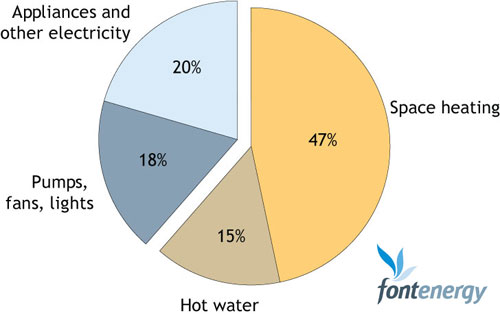
The pie chart above shows that of the emissions from houses in 2050, almost 2/3 will come from heat. Electricity, on the other hand, will only make up just over a third of emissions. Without radical action to decarbonise heat, we won’t get anywhere near the 2050 target.
Climate Act requires all homes built after 1917 to go zero carbon
Posted in climate change, energy, renewable energy, sustainability, zero carbon on February 2, 2009| 9 Comments »
Sounds crazy but it’s true.
Here’s a graph I put together showing the number of houses of various ages up to 2050. It clearly shows that, using current demolition rates, the vast majority of the homes in use in 2050 have already been built. Details on how I put the graph together can be found in a previous post.
zero carbon must not depend on private wires
Posted in Code for Sustainable Homes, private wire, renewable energy, SAP, zero carbon on January 19, 2009| 8 Comments »
In a blog post earlier this month, Mark Brinkley wrote that the zero carbon agenda is dependent on private wire networks, which he contends are anti-competitive. While I have a lot of respect for Mark, in this case his arguments aren’t valid. Here’s why.
zcc IV: what does 70% mean?
Posted in climate change, Code for Sustainable Homes, renewable energy, sustainability, zero carbon, tagged zero carbon consultation on January 9, 2009| 1 Comment »
CLG drop quite a few hints in the zero carbon consultation that they’re prepared to set the carbon compliance requirement at 70%. In other words, new schemes would have to achieve a reduction of 70% in regulated emissions relative to 2006 regulations. But if you look a little closer, it soon becomes clear that this figure isn’t what it seems.
-
Join 1,209 other subscribers
categories
Recent Comments
Why Ofgem must stick… on how many old homes will get he… Marko Cosic on Testing, testing Martin Winlow on the myth of stone walls as… Martin Winlow on the myth of stone walls as… Martin Winlow on the myth of stone walls as… AlanDHill@hotmail.co… on the myth of stone walls as… Comment: What would… on why we’ll share Open… Top Posts
archive
- May 2024
- January 2019
- August 2018
- October 2017
- July 2017
- March 2017
- January 2017
- November 2016
- October 2016
- September 2016
- July 2016
- May 2016
- April 2016
- March 2016
- February 2016
- January 2016
- October 2015
- August 2015
- June 2015
- April 2015
- March 2015
- January 2015
- December 2014
- November 2014
- October 2014
- September 2014
- June 2014
- May 2014
- April 2014
- March 2014
- January 2014
- December 2013
- November 2013
- October 2013
- February 2013
- January 2013
- July 2012
- June 2012
- May 2012
- April 2012
- March 2012
- June 2011
- January 2011
- October 2010
- August 2010
- June 2010
- April 2010
- March 2010
- February 2010
- January 2010
- October 2009
- September 2009
- August 2009
- July 2009
- June 2009
- May 2009
- April 2009
- March 2009
- February 2009
- January 2009
- December 2008
- November 2008
- October 2008
- September 2008
- August 2008
- July 2008
- June 2008
- May 2008
- April 2008
- March 2008
- February 2008
- January 2008
- November 2007
- October 2007
- September 2007
- August 2007
- July 2007
- June 2007
- May 2007
- April 2007
- March 2007
- February 2007
- January 2007


 carbon limited