Feeds:
Posts
Comments

As currently proposed, the feed-in-tariffs are likely to be the exclusive domain of the middle class with lower income households shut out from participating.

To prevent the FiT being accessible only to the middle classes, it needs to be set at a level that allows banks and private equity providers to step in and cover the capital costs of PV while sharing some of the benefit with householders.

In order to be attractive, the return needs to be between 7.5% and 8.5% (ungeared) depending on interest rate and how the FiT revenues are taxed. Some institutional investors say it needs to be higher, but if we stick to this figure we stay on the conservative side.

Taking PV as an example, the FiT as currently proposed would generate a 3-4% return in a mature market (e.g. £4700/kWp installed for a household system as we’re seeing in Italy). In a less mature market (e.g. £5.5k/kWp) the return would be 1.9%.

Looking at it another way, in order to achieve a 7.5% return in the real world based on the proposed FiT, the installed price of PV would need to be £3350/kWp! The other £1.35k is value shortfall (i.e. the difference between £3.35k and £4.7), which might be covered by an eco-minded middle income household but will certainly not be attractive to a low income household.

Bottom line: the proposed FiT for PV is too low. In order to provide an 8% return in a mature market (£4.7k/kWp installed for a small system), the FiT needs to be set at around 55p/kWh. For the largest schemes (>100kW), this would step down to 37p.

Sorry I’ve departed from my usual policy of putting all the underlying numbers up. The calculations are pretty straightforward but they require a spreadsheet and I don’t have a public facing version yet.

Linked In seems to be nothing but a tool for head hunters. I’m not looking for a job so what good is it? I find my finger hovering over the delete button.

Has Linked In done anything for you? Phil? Mel? Anyone?

Although PAYS has been conceived to address retrofit, developers and RSLs are hoping it might also reduce the financial burden of meeting more stringent upcoming regs for new build.

In theory it works like this: by capitalising future energy savings, developers could afford to put in the low carbon measures they need to in order to hit strict limits on emissions. The occupants then use a portion of the savings to pay off this capital lump.

Developers hit their targets and occupants get savings. Everyone’s a winner. But in the case of new build, what are the savings measured against? The UKGBC final PAYS report suggests that:

Continue Reading »

I spent yesterday at Alex Moody’s house (ex-colleague at XCO2) eating barbequed pizza (awesome) and wiring up a home-made PV panel from single cells (even better). Equipped with an almost-hot-enough soldering iron, I was a one man tabbing line while Alex put the wooden box together. When I left in the late afternoon, Alex took over and finished the lot.

AM-PV

This panel will one day power Alex’s LED-based garden lighting. Next steps are to get the string working with the charge controller and battery.

At Fontenergy, we’re doing some industrial PV installations in Italy. I’m really looking forward to seeing them up and running but I can’t help feeling that building a single 60W panel from scratch might be more satisfying (if in a slightly different way) than seeing a rooftop covered with someone else’s panels.

links for 2009-09-02

  • Something to think about in the current UK energy debate:

    The CEO of the French state-owned company Aveva said it was impossible to determine the final cost of the Finnish project, raising concerns that there could be more charges to come. The project, originally due to come on line in 2009, is already three years behind schedule.

    But don't worry, it's not all bad news. Apparently despite this dismal performance on the first new Western nuclear plant in decades, Aveva's order backlog is at a record high. Hurray!

Biodiesel will almost certainly be a recognised fuel under to upcoming changes to building regs, opening the door to biodiesel CHP as a way to meet increasingly stringent limits on emissions. While a number of big urban developments will breathe a sigh of relief at the news, it’s not all plain sailing. Continue Reading »

I’ve just finished watching the first of three episodes of The Future of Food on iplayer. In it there’s a fascinating interview with Hilary Benn, secretary of state for DEFRA. Fascinating not because of what he says, but what he doesn’t say. On this programme about the upcoming global food shortages (mainly due to fuel prices, water shortage, and changing climate), he says:

We know we’re going to have to grow more food with a changing climate and probably less water being available… I think looking at what happened last year, the food riots, the rise in prices, we’ve got to take responsibility now to ensure that people have enough food to eat.

Continue Reading »

Isabelle McKenzie has put up a very useful post on the Fontenergy blog describing the practicalities of third party access for private wire networks. She starts with background info on the Balance and Settlement Code before going on to outline the two main strategies for allowing third party access.

Will private wire always be an option for small schemes? Maybe not, but until DECC and OFGEM can come up with an alternative, these schemes will need to tread carefully to make sure they’re adhering to best practice and not being anti-competitive. Have a look.

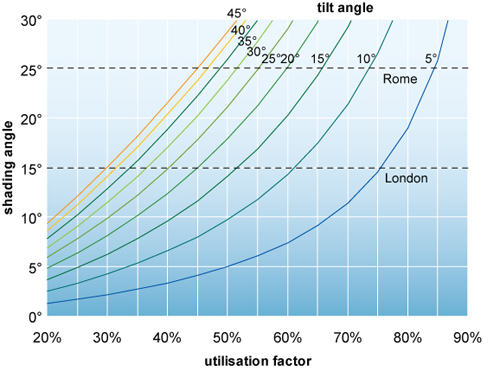
Following on from discussion about planning reports last week, here’s a chart I put together showing roughly how much PV you can fit on a flat roof. It’s based on the formulas described by Volker Quaschning, the German Godfather of Sol (Thank you! I’ll be here all week. Try the crab).

Solar-shading

The shading angle is the angle from the bottom of the panel behind to the top of the panel in front. As a rule of thumb, you can use the height of the sun at noon on the winter solstice – for London, this is about 15°. Utilisation factor is the ratio of panel area to roof area.

Continue Reading »

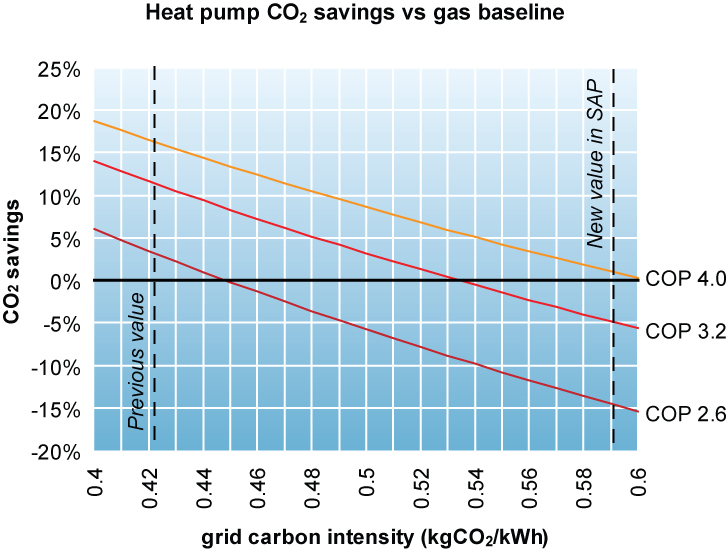
The new SAP has a revised carbon intensity for grid electricity (set in the consultation at 0.591 kgCO2/kWh, up from 0.422). This has a big impact on the resulting carbon emissions from heat pumps, in most cases making them higher than emissions from the worst boiler you can legally install. This goes for both air source and ground source.

You can see from the graph above that at a grid carbon intensity of 0.591 even a GSHP with a COP of 4 is struggling to outperform an 86% efficient gas boiler. The real world COPs seen at Barratt’s Chorley scheme (2.6 for GSHP) and recent field trials by Mitsubishi  (3.0 – 3.4 for ASHP according to a letter from Mitsubishi in the latest CIBSE mag) mean that heat pumps would emit significantly more carbon than the boiler.

And yet in the low carbon transition strategy, DECC state that heat pumps will be eligible for the Renewable Heat Incentive (pdf – see para 1.22), rewarding them for being a renewable energy source! What the hell are they thinking?

Here’s how I did the numbers:

Continue Reading »

Design a site like this with WordPress.com
Get started