September 27, 2007 by Casey Cole
In Building yesterday, a study by London South Bank University says a quarter of schemes in London are exceeding the 10% target. The article states:
In total the study, undertaken by London South Bank University, looked at 113 detailed energy statements for schemes that had been given planning approval.
Erm, but none of those scheme has been built yet. And currently there’s no mechanism for enforcing adherence to the commitment by developers – unless it’s written into a Section 106. This enforcement mechanism is a tricky issue that hasn’t been resolved as far as I know. The study also finds that:
…the most effective technologies at cutting carbon are CHP and CCHP, particularly where biomass fuel is used.
Fantastic, and I’m looking forward to seeing more biomass in London. We’ve specced it on a number of jobs, the first of which is up and running. But I can say that using biomass heating (never mind biomass CCHP) brings its own logistical tangles. It’s one thing to tot it up on a spreadsheet and another entirely to bring to fruition.
Without succumbing to the pessimism that seems de rigeur when blogging about the government’s or the GLA’s green policies, I’d just like to add a note of caution. The schemes have been granted planning permission but are by no means home and dry. A follow up survey is needed to see what’s actually built.
Posted in biofuel, biomass, chp, climate change, energy, engineering, london, micro chp, renewable energy, sustainability | Leave a Comment »
September 8, 2007 by Casey Cole
(Spotted by Mel at Elemental) Cyril Sweett have published their research into the potential for improving energy performance of existing building stock. The importance of greening existing buildings is brought home by two facts:
- 44% of all CO2 emissions in the UK comes from energy use in buildings
- According to one of the report’s authors, in 2050 60% of Britain’s buildings will still pre-date the 2006 revisions to Part L
So we can look forward to the carbon reductions required by Part L being ratcheted up in future, but the overall effect will be modest, even in the long term. If we want to save carbon NOW then energy consumption in existing buildings is too important to ignore.
Predictably, the report’s top recommendation is for “brave decisions” by the government. But in a political climate where politicians would rather engage in creative accounting than be decisive on climate change, it’s hard to be hopeful.
Posted in architecture, climate change, energy, engineering, london, renewable energy, sustainability | 7 Comments »
September 4, 2007 by Casey Cole
What’s going on?
There’s been a fierce debate among energy bods this summer over the environmental effectiveness of combined heat and power (CHP) and CHP with cooling (CCHP) – a debate closely tied to assumptions about the carbon emissions associated with grid electricity in the UK.
What happened?
As noted in this blog in May, Arup associate director James Thonger opened up with a broadside aimed at the GLA policy of requiring CHP and CCHP on new developments. In particular he refuted LCCA claims that gas CHP saves 54% of carbon relative to grid electricity. The LCCA is headed up by Allan Jones, former green god of Woking and now darling of the London Mayor, who didn’t take the criticism lightly.
Continue Reading »
Posted in chp, climate change, energy, engineering, london, micro chp, renewable energy, sustainability, utilities | 8 Comments »
August 24, 2007 by Casey Cole
 Following our recent blog conversation about the energy consumption of Portcullis House, Phil at the Sustainability Blog has pointed out the recently published consumption figures for another Hopkins scheme – this time the Gibbs Building owned by the Wellcome Trust. Like Portcullis House, it’s an office building kitted out with plenty of green gear. And like its cousin, the Gibbs Building is consuming more energy than predicted at design stage. So is the green office building just a myth?
Continue Reading »
Posted in architecture, climate change, energy, engineering, london, renewable energy, sustainability | 6 Comments »
August 7, 2007 by Casey Cole
An article in the Times over the weekend claims that walking to the shops emits more CO2 than driving. It’s a sensationalist claim (even if they can back it up with calcs) that doesn’t help anyone except Daily Mail readers desperate to shore up their view that anyone who thinks about energy or the environment is a commie pinko control freak determined to spoil everyone’s fun. Chris Goodall, the man behind the claim, should have known better and is clearly more interested in headlines than making a genuine difference.
Every little helps. But all things being equal, the fight to alleviate the effects of global warming isn’t going to be won between your house and the shops. It’s much more useful to keep your eye on the crucial issues rather than handing ammunition to the folks who like nothing better than a bit of obfuscation.
Posted in agriculture, climate change, consumerism, energy, engineering, renewable energy, sustainability | 6 Comments »
July 30, 2007 by Casey Cole
Via zerochampion, the Guardian’s architecture commentator suggests that buildings
…should only really be offered prizes 20 years after their completion. While we can comment on the merit of the design, look and feel of a particular building when new, and celebrate the intentions of its designers, there is no guarantee that it might not prove to be a failure.
I know we ought to be happy that architecture is being discussed on TV at all. Having said that, if I were in charge of the Stirling Prize I’d consider actual measured energy use and give occupants a vote on whether they think the building is a success.
Posted in architecture, climate change, energy, engineering, london, sustainability | 3 Comments »
July 25, 2007 by Casey Cole
Client (on seeing the staircase dominating his hall): But I didn’t want a black marble staircase, I wanted an oak one!
Lutyens: What a pity.
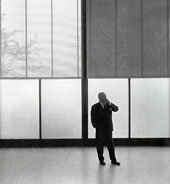 This is driving me nuts. There’s now a huge emphasis on sustainability in architecture but some architects still don’t get it. Aflame with good intentions at the start of projects, they enthusiastically buy into sustainability concepts. But later in the design when there’s a perceived conflict between the energy performance and the architecture, the energy performance is chucked out the window.
Continue Reading »
Posted in architecture, climate change, energy, engineering, london, renewable energy | Leave a Comment »
July 10, 2007 by Casey Cole
 Via No Impact Man, I came across an article by Johann Hari, originally published in the Independent in 2006. In it, Johann traces the roots of the ongoing conflict in Democratic Republic of Congo to the scramble for natural resources; in particular coltan, a metal used in electronics like mobile phones and Playstations. 80% of the world’s supply of coltan is found in the DRC, where 4 million people have died in five years.
The choices we make, especially in the goods and energy we consume, have a direct influence on the lives of others. It’s difficult to mentally connect my cell phone and a mine in DRC, but the connection is there whether I choose to see it or not. My standard of living doesn’t exist in a vacuum and you could question how much of it I have a legitimate right to.
Posted in consumerism, sustainability | 1 Comment »
July 4, 2007 by Casey Cole
Mechanical ventilation with heat recovery (MVHR) is often put forward as part of a low-energy design strategy for homes. The principle is that you build your house air-tight to minimise air infiltration and then mechanically supply fresh air via a heat exchanger. This heat exchanger captures the heat energy in the warm outgoing air and transfers it to the fresh incoming air. Some MVHR units can reclaim as much as 90% of outgoing heat, potentially making drastic cuts to your heating load while maintaining high internal air quality (that’s the theory). All of this is part of the build tight, ventilate right strategy that you hear so much about.
But how air-tight do you have to build before MVHR makes sense? I took a look using SAP 2005, and here are the results:
Continue Reading »
Posted in climate change, energy, engineering, renewable energy | 5 Comments »
July 2, 2007 by Casey Cole
 Next year we reach a milestone unprecedented in history when more than half of all people will live in cities. This comes from the UN’s new State of the World Population report, which strikes an interesting tone. The authors acknowledge the huge risks of increasing rates of urbanisation, particularly for the poor, but also maintain that if we get our urban planning and public administration right, we can design out the worst of our environmental and social problems. And anyway, urbanisation is inevitable because you can’t have economic growth without it.
You could argue that here in the developed world, we’ve got enough urban planning experience under our belts to allow us to meet the challenge. Except that the developed world is not where the real expansion is set to take place. Most of the shift will occur in Asia and Africa where “the accumulated urban growth of these two regions during the whole span of history will be duplicated in a single generation.” So to describe the pace of expansion as breakneck is putting it mildly.
Continue Reading »
Posted in architecture, climate change, energy, engineering, london, renewable energy | 3 Comments »
« Newer Posts - Older Posts »


 carbon limited