Feeds:
Posts
Comments

Last week, Bill Watts at M&E practice Max Fordham wrote a passionate rant against CHP and heat networks on the Construction Manager website.

The crux of Bill’s message is that real world losses on new build projects are higher than losses calculated using manufacturers’ specs and SAP. How much higher? Bill’s not sure – he says that only ESCOs know how well or how poorly heat networks are working. But in any case “much higher than we’ve been led to believe.”

A few days after the original article appeared, Construction Manager ran a follow up piece in which people from the building industry try to rebut Bill’s argument. In general the respondents make the case that CHP and DH have an important role to play in decarbonising heat, with several highlighting that the Heat Network Code of Practice should improve the performance of new networks.

But in my view the industry respondents missed the key point.
Continue Reading »

Final energy

UK Energy by End Use

Nearly all of the primary energy we use in the UK is in the form of  coal, oil and gas. This energy is the source of almost all our emissions – emissions which must be slashed to reduce the risk of catastrophic climate change.

When considering this challenge, rather than look at the primary energy, it’s useful to look at what we use the energy for.

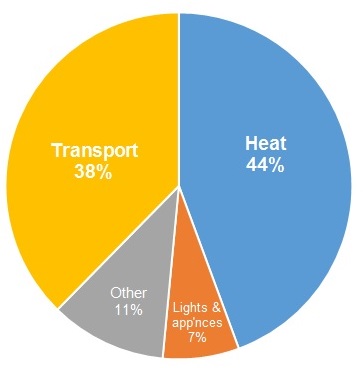
Given the recent press about “keeping the lights on” you might think most of our energy is for generating electricity for lighting and appliances. But you’d be wrong. Using DECC’s energy consumption statistics for the UK, I put together the pie chart above to illustrate.

The result? We mainly use energy for just two things: heat and transport. In other words, almost all the energy we use is for warming things up or moving things around. And only a tiny proportion is for lighting.

So the next time you hear the word energy, don’t think electricity. Don’t even think oil and gas. Think heat and transport – this is where we’ve got to innovate to meet our carbon targets.

In the previous post, I highlighted where innovation is taking place in the UK district heating market. In this post, I’d like to flag up some important areas where innovation isn’t happening – but really should be. Below are a few of the biggest blocks in the market, where change is desperately needed but so far not forthcoming.

Continue Reading »

I’ve been invited to do a short talk at a UK Trade and Industry event for investors in heat networks, giving an overview of innovation in the sector. This gives me an excuse to do some research and summarise it in this post – and also an opportunity to ask readers what I’ve missed.

Continue Reading »

In the previous post, I gave some of the reasons why I hate Big Data. In this post, I’d like to talk about Big Data’s modest and more human cousin: medium data.

I’m sure someone out there has already coined the term and it’s acquired a particular definition in the argot of IT consultants. But at the time of writing it’s not yet in general use, so I’ll take the opportunity to appropriate the term “medium data” and tell you what it means to me.

Continue Reading »

why I hate Big Data

There’s a lot of noise about Big Data, with much of it in the energy space. The rise of the Internet of Things, self-learning thermostats, the success of O-Power – all are linked to the generation and automated processing of massive datasets.

The hype machine promises that Big Data will solve all sorts of problems and make the world a better place.

But hype or no hype, personally I hate Big Data.

I can hear the sharp intake of breath at Guru’s PR company, who’ve done a great job getting press coverage for “Big Data” work that we’ve done for the Department for Energy and Climate Change. Bear with me guys, I’ll explain in this post.

First, a clarification of terms: there’s a tendency to refer to any large dataset as Big Data, even when it isn’t. If you’re not sure what Big Data is, here’s a nice background piece by Tim Harford, the FT’s undercover economist.

So what’s wrong with Big Data? Here are some examples:

Continue Reading »

pllWith the election looming, it’s time to nail your colours to the mast. Ain’t no purdah round here, so here’s my contribution…

If I were Secretary of State for Energy and Climate Change, my mission would be to put us firmly on the path to zero carbon heat and electricity. Only by doing this will we meet our legally binding promise to decarbonise the UK economy and mitigate the worst effects of climate change.

As you’ll see, I also wouldn’t get too hung up on where my remit officially stopped.

To get back on the path, we’ll need to radically improve energy efficiency, develop our ability to shift electricity demand, enable renewables to meet the bulk of our electricity requirements, and rapidly develop our district heating market.

First: ramp up energy efficiency

Continue Reading »

In January I wrote a post about the fact that, contrary to expectations, no meters will be retrofitted under the new Heat Network Regulations. This is because the assumptions in DECC’s meter viability tool mean almost no install will pass the financial viability test.

After hitting publish on that post, things moved pretty fast.

Continue Reading »

In the last post, I flagged up the fact that no heat meters will be fitted to homes on heat networks under the Energy Efficiency Directive. This is because, no matter what inputs you feed into DECC’s calculation tool, the output is always the same: heat meters aren’t viable.

As a result, around 300k homes with unmetered connections will continue to pay a flat fee regardless of how much heat they use, robbing them of control over spending and giving them no incentive to save.

In this post, I’ll show that heat meters are viable in a typical block of flats. I’ll also show how a single unrealistic assumption in the DECC calculation tool pretty much guarantees that the computer says no, every time.

Continue Reading »

That’s right. None. Zero. Zilch.

This is because, using DECC’s calculation tool, there are no cases in which the retrofit of residential heat meters is considered “financially viable.” No matter what numbers you feed into the calculation tool, the output for homes on heat networks is always the same:

Heat meters are NOT viable on an average building(s) of this type.

This means that the EU Energy Efficiency Directive has just been rendered toothless. Huge savings from behaviour change and efficiency improvements will not be realised. The 75% of people on heat networks with unmetered connections will continue to pay a flat fee regardless of how much heat they use, robbing them of control over spending and giving them no incentive to save. At the same time, heat network operators will be forced to engage in needless calculations and reporting, the outcome of which was decided before they even downloaded the calculation tool.

Continue Reading »

Design a site like this with WordPress.com
Get started