Feeds:
Posts
Comments

SHOW ME THE DATA

…or “How to end dogma-driven design”

money

Building design professionals are often driven by theories and ideology rather than facts. But whether we’re talking about heat networks or air-tightness, photovoltaics or passive ventilation, design decisions should be based on data, not dogma. It’s time to stop arguing, start measuring and learn from the results.

Continue Reading »

Sonderby

Heat network at Sønderby – images from linked design guide


When writing a recent post about the low temperature DH network at Lystrup, I contacted the author of the related technical report, Jan Thorsen. In Jan’s response he kindly included a copy of Guidelines for Low-Temperature District Heating (PDF).

This guide is essential reading for designers and operators of DH systems. It shows how DH with flow temperatures of around 55 and return temps of around 25 (also called “fourth generation” or “4GDH”) can be used to serve high efficiency homes as well as buildings on low heat density networks.

At this point you might say, hang on a minute – what are we doing considering 4GDH when we struggle to deliver decent 3rd generation (70/40) networks in the UK? And I’d say you’ve got a point. In fact, I spent a depressingly large chunk of last week trying to help salvage the efficiency of another new network that is horrendously oversized and was probably doomed to low efficiency before it even left the drawing board. So I’m sympathetic with the view that UK engineers need to get our houses in order before moving onto the cutting edge stuff.

But looking ahead to the strategies employed in more advanced, lower temperature systems helps to highlight the design principles that we should be focusing on, even on today’s projects in the UK.

Continue Reading »

Continue Reading »

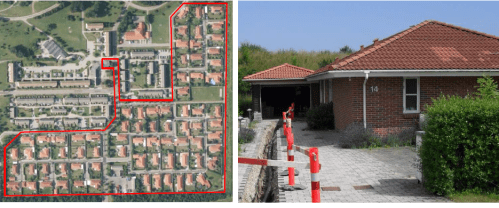
Highly efficient homes on Lystrup Network – img from linked report

I was recently given a copy of this fascinating report describing a 2-year study of a district heat network serving 40 highly efficient homes.

Using district heat in this way flies in the face of the prevailing view in the UK, which is that DH is incompatible with low energy housing. In this country we assume that low heat demand in homes means that heat losses from the network will always outweigh useful heat delivered.

But as you’ll see in this post, this view isn’t correct. The Lystrup Danish network serving near-Passivhaus-standard terraced homes has just 17% losses. Achieving this required a very low temperature heat network as well as careful design, commissioning and monitoring of the resulting system.

For engineers and district heat geeks, the report is packed with fabulous nuggets of information, the most interesting of which I’ve pulled out in the following post. If you’re not a DH geek, I imagine you’ve already stopped reading and are now watching Strictly.

Still here? Strap in and let’s GEEK OUT!

Continue Reading »

I’ve done a blog post for the CHPA in the run up to the Heat 2014 conference on 5 November. Here’s the intro and link:

Metering and billing (M&B) is often seen as a necessary but rather dull cog in the district heating machine. For many heat network operators, heat metering is nothing more than a tool for ensuring customers are billed for the heat they consume. But it’s far more important than that. Heat metering can be used to monitor network efficiency, which can spell life or death for district heating schemes. Unfortunately, getting this performance data out of heat meters isn’t always easy…

Read the rest here.

When your opinions change, it’s easy to convince yourself that you’ve held the new view all along. For example, there’s been plenty of historical revisionism in the aftermath of the financial crash of 2008, where commentators have convinced themselves they’d seen it coming.

More prosaically, when it comes to low carbon energy you find an uncanny alignment between the products people sell and their views on the best means of lowering carbon. People who work for heat pump companies believe that the electrification of heat is a necessity. Those who sell solar know that PV is essential for curing the UK’s energy woes.

Continue Reading »

NestThe internet is abuzz with a smart home backlash, spearheaded by Lloyd Alter of Treehugger, who made a splash when he recently wrote in the Guardian that a smart thermostat would be “bored stupid” in a Passive House.

So is it true that a smart home “throws technology and electricity at a problem that is better solved by design?”

Continue Reading »

It’s been a long and protracted death, but the Queen’s Speech finally spelled the end for plans to drastically reduce emissions from new build.

Continue Reading »

Octavia_Elizabeth_House_WembleyWe’re using our Guru smart metering and control platform to do real-time monitoring of district heating at Octavia’s flagship site in NW London. Our aim is to eliminate the two biggest risks that DH operators face: bad debt and hidden inefficiencies. Here’s an article summarising what we’re up to.

Want to stay updated? Subscribe to email alerts for this blog or follow me on twitter.

badwolfblow

The EED: genuinely dangerous or just misunderstood?

Inside Housing published an article last week about the “significant costs” that will be imposed on heat network operators (HNOs) as they are forced to install heat meters under new regulations that come into force next month.

Designed to grab the attention of housing associations, the article focuses on the costs of complying with the EU Energy Efficiency Directive (EED) – and it completely ignores the key benefits: huge improvements in energy efficiency, cost savings for DH customers and greater transparency in how these networks are performing.

While I think the Inside Housing article completely lacked balance, I agree that a wakeup call is overdue. A few organisations are planning for the EED but most don’t even know it’s coming. People need to get informed, and fast – because the implications for operators and consumers of district heat are huge.

Continue Reading »

Design a site like this with WordPress.com
Get started