Feeds:
Posts
Comments

you are what you eat

The-Master-Switch-Wu-Tim-9780307269935I recently met with the CTO of a new electricity supplier, set to enter the market later this year. During the conversation he suggested a book called The Master Switch by Tim Wu. I picked up a copy and have brought it away on holiday. I’m just getting stuck in, so I’ll reserve judgement, but one particular passage struck a chord:

…just as you are what you eat, how and what you think depends on what information you are exposed to. How do you hear the voice of political leaders? Whose pain do you feel? And where do your aspirations, your dreams of good living, come from? All these are the products of the information environment.

In a world drowning in content, your attention is the scarcest commodity of all. Organisations spend billions trying to access the sensory channels by which your brain takes in information, even if it’s only for a moment. That might be all it takes to nudge you into a purchase or a point of view. As a human being in the 21st century West, you have to guard these channels carefully by deliberately choosing the sources of information that you’ll spend your precious attention on.

Once you’ve done your best to choose good sources of information, you still have to think critically about the messages. Swallow them whole and before you know it you might hear yourself espousing a viewpoint you didn’t form yourself. Or driving a Range Rover. Or inexplicably sporting a beard.

Picture3

This is number 7 in a series on district heating. Here’s where to find  1, 2, 3, 4, 5 and 6.

Your district heating network might be perfectly designed, but if it’s not installed and commissioned right it is doomed to fail, potentially costing you and your tenants a huge amount of money. In this post, we’ll talk about how to get DH install and commissioning right.

Continue Reading »

This is the sixth post in a series on district heating. Here’s where to find  1, 2, 3, 4 and 5.

We’ve looked at how district heating (DH) can go wrong. Now let’s look at ways to help make sure it goes right. First: design.

Continue Reading »

This is the fifth post in a series on district heating. Here’s where to find  1, 2, 3 and 4.

So far we’ve looked at how poor design, installation or commissioning can doom a DH network to poor efficiency. In this post, I’ll briefly outline why it’s important to monitor and look after a DH network throughout its life, and what can go wrong if you don’t.

Most DH systems are commissioned and then ignored. It may be many months or even several years before anyone revisits the scheme to look closely at how it’s operating, usually prompted by something going badly wrong. The first casualty of network neglect is efficiency.

Continue Reading »

Using Greg Barker’s written response to Caroline Flint on 19 December, here’s a sickening illustration of how the current government has eviscerated the UK drive towards domestic energy efficiency. And those 2013 ECO figures are from before the government gave in to Big 6 moaning and cut the ECO targets in half! It’s difficult to imagine a government caring less about energy efficiency, emissions and fuel poverty.

Insulation-after-CERT

All those bare components add up!

All those bare components add up

This is the fourth post in the series. If you haven’t yet, check out the first, second and third posts first.

Poor installation and commissioning can bring even the best designed network to its knees. In this post, I’ll look at some of the ways these crucial phases go wrong. First, installation:

Continue Reading »

This is number 3 in a series on DH. Here’s where to find the first and second posts.

A key way district heating networks go wrong is through poor design. This can come from:

  1. a lack of good engineering
  2. a lack of relevant standards and guidance
  3. a perverse incentive for engineers to be overly conservative in order to protect their PI insurance
  4. clients not knowing what to ask for from their contractors

In this post, I’ll take a closer look at these problems.

Continue Reading »

This is the second post in a series on DH. The first can be found here.

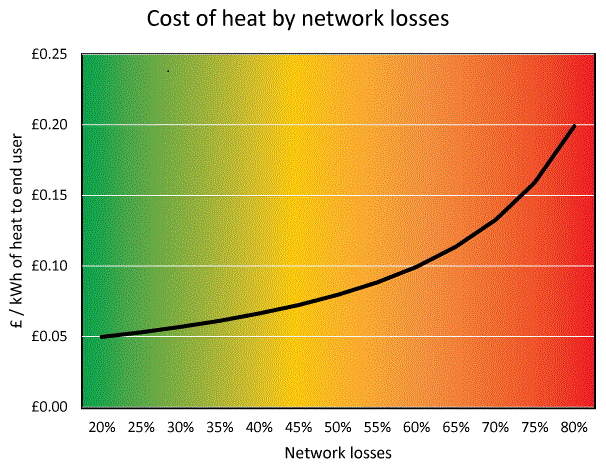
As I mentioned in my previous post, cost of heat on DH schemes is directly tied to system efficiency. The more efficient the system, the less fuel is needed to meet the heat requirements of the customers. And of course the reverse is also true: lower efficiency means higher cost of heat. This relationship between efficiency and cost is hugely important: it’s real cash, coming from residents to pay their heating bills and from the landlord or ESCO to pay the fuel bill.

In fact, I’d go as far as saying that efficiency is the single most important issue for DH schemes. This post explains why efficiency matters so much.

heat-price-by-losses1

Continue Reading »

District heating (DH) has become a common strategy for new developments to reduce carbon in order to satisfy planners and meet building regs. But despite its prevalence, in the UK we frequently get district heating wrong.

Most of what we do at work relates to DH in one way or another. At Insite we provide meter reading and customer care to several thousand people on district heating schemes. We take residents’ calls, help clients set tariffs and assess efficiency data, among other things. At Fontenergy (one of Insite’s two parent companies) we’ve project managed the design and install of DH networks and we operate centralised plant for ourselves and others. In our efforts to get DH right, we once even imported one of the best DH contractors from Denmark and worked with them to install a network in North London.

When it’s done right, DH is a cost-effective strategy for delivering low carbon heat. What’s more, it’s an essential technology for decarbonising heat in the UK (mainly because relying entirely on the theoretical decarbonisation of the grid in order to electrify heat is nuts, but that’s another post). The reality is we need DH, but often we don’t do it right.

Continue Reading »

I was at a conference last week on smart metering in Cambridge. A guy from Anglian water reminded us all that the water network in England and Wales loses 3.36Bn litres of water each day due to leaks. That sounds like a lot – is it?

If the average person in the UK uses 150 litres per day, that means we’re losing enough clean, pure water for 22.4 million people every day. There’s only 56m people in England and Wales, so that’s enough water for around 40% of the population!

I’m stunned.

Design a site like this with WordPress.com
Get started