Biodiesel will almost certainly be a recognised fuel under to upcoming changes to building regs, opening the door to biodiesel CHP as a way to meet increasingly stringent limits on emissions. While a number of big urban developments will breathe a sigh of relief at the news, it’s not all plain sailing.
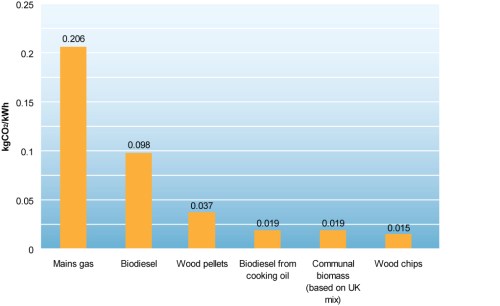
In the proposals for the new SAP, biodiesel has a much higher carbon intensity that biomass (see graph below). So emissions from a biodiesel system will be correspondingly higher than the “equivalent” biomass system.
Couple this with the fact that the same carbon intensity will apply to both grid electricity consumed and grid electricity offset (i.e. no more carbon bonus for offsetting grid electricity) and biodiesel CHP may struggle to achieve carbon compliance.
Taking a dwelling with very high thermal efficiency, the variation of carbon savings by proportion of heat supplied from biodiesel CHP looks like this:

Given the extreme peakiness of domestic loads (especially if domestic hot water is instantaneous via a hydraulic interface unit), it’s likely to be difficult to meet a significant proportion of the heat load from CHP. At the very least, large, carefully sized thermal stores will be needed.
But even meeting half of all heat demand from biodiesel CHP would only achieve a carbon reduction of less than 25%. Combined with reductions from efficiency measures, this is unlikely to get to the 45% (or so) reduction that will probably be required to achieve carbon compliance under the zero carbon definition.
Other risks associated with biodiesel remain unchanged:
- The price of biodiesel is higher than gas (and wood chips), requiring higher heat tariffs. This is a critical issue for RSLs. Private sale units may be more difficult to market.
- Schemes using biodiesel will have to compete with demand from the transport sector as it responds to the RTFO and wider carbon targets. This is likely to drive prices up further.
- There are still significant doubts about the sustainability of most biodiesel, and its use brings PR risk.
So in summary, when faced with the challenge of achieving zero carbon, biodiesel might sound like a simple way out. But this is not the case.
Here are the numbers behind the CHP graph above. The baseline (using gas boilers and grid electricity) looks like this:
| Primary energy | Assumed efficiency | Useful energy | CO2 kg/kWh | kgCO2/yr | |
| Space heating | 16.7 | 90% | 15 | 0.206 | 3.4 |
| Water heating | 33.3 | 90% | 30 | 0.206 | 6.9 |
| Electricity | 40.0 | 100% | 40 | 0.591 | 23.6 |
| Total kgCO2 | 33.9 | ||||
The CHP assumptions look like this:
|
And the CHP calculation looks like this:
| CHP | Backup systems | ||||||||
| Useful energy demand (kWh) | Demand met (kWh) | Primary energy | CO2 kg/kWh | kgCO2/yr | Demand met (kWh) | Primary energy | CO2 kg/kWh | kgCO2/yr | |
| Heat | 45 | 22.5 | 31.3 | 0.098 | 3.1 | 22.5 | 27.8 | 0.206 | 5.7 |
| Electricity | 40 | 13.5 | 17 | 0.098 | 1.7 | 26.5 | 26.5 | 0.591 | 15.7 |
| Subtotal CHP CO2 | 4.7 | Subtotal backup CO2 | 21.4 | ||||||
| Total kgCO2 | 26.1 | ||||||||
| Savings | 23.1% | ||||||||


 carbon limited
Isn’t there a serious enforcement issue here, because surely the CHP operator can just substitute mineral diesel and biodiesel at will depending on the price at any given time?
Also your graph shows a lower emissions factor for biodiesel from cooking oil. Who is going to check the source of the fuel, and how?