PAYS (“Pay As You Save”) is getting a lot of airtime these days. Born in the US, it figured largely in yesterday’s low carbon transition strategy and the Government clearly hope it will take the pain out of the £10bn per year (or so) that needs to be spent on improving existing stock.
Archive for the ‘engineering’ Category
how good is PAYS?
Posted in architecture, engineering, utilities, tagged Pay As You Save, PAYS on July 17, 2009| 8 Comments »
what is an ESCO?
Posted in chp, energy, engineering, ESCO, private wire, renewable energy, sustainability, zero carbon on June 11, 2009| 1 Comment »
Most people who work in the built environment agree that ESCO stands for Energy Services Company. But that seems to be the only thing about ESCOs that everyone agrees on – the term can mean vastly different things to different people.
So what is an ESCO?
The short answer is: there’s no one answer. Here’s a rough list of the services that an ESCO might offer. Keep in mind that a company might provide all, some, or only one of these services and still call themselves an ESCO:

help wanted (bypassing the middle man in practice)
Posted in engineering, other stuff on June 2, 2009| Leave a Comment »
I wrote a post in April about a new, more collaborative way of working. It turns out Mel Starrs had been thinking along similar lines. Then Jackie Sadek at Estates Gazette wondered if we should bypass the recruitment agents in the construction and sustainability sector, applying a collaborative model not just to working but also recruitment.
In that spirit, here’s an experiment. Nick and Julian at Brooks Devlin are looking to hire a new person. They’re a small practice doing great work – and as a small practice, hiring the right person is absolutely crucial.
Talking to Nick about this yesterday I suggested that advertising via web 2.0 might be interesting as the audience is self-selecting; I suspect you’re more likely to get motivated, interested, intelligent, autonomous people via blogs, twitter, etc. Anyway here’s the blurb Nick sent:
Brooks Devlin is a small and successful Environmental Design Consultancy based in West Dorset and is seeking a new team member to assist in delivering our increasing workload. We are looking for an experienced Code for Sustainable Homes assessor, preferably with other BREEAM and SAP accreditations.
Our core services include CSH assessments, renewable energy strategies, daylight modelling and SAP/ new build EPC’s. We have a wide client base with projects across the southwest, south and London regions. Our projects ranging from one-off low energy houses to 5,500 home master-plans, but also includes commercial, education and healthcare.
The position is based in Bridport, West Dorset. Remuneration will be commensurate with experience and capability. Interested parties should call 01308 428918/01308 428917 and speak to Nick Devlin or Julian Brooks. Alternatively email CVs to enquiries@brooksdevlin.com.
Link to it, tweet it, digg it, whatever you like, but if you think you have access to a network of people who might be interested, pass it along.
Brooks Devlin is a small but successful Environmental Design Consultancy based in West Dorset and is seeking a new team member to assist in delivering our increasing workload. We are looking for an experienced Code for Sustainable Homes assessor, preferably with other BREEAM and SAP accreditations.
Our core services include CSH assessments, renewable energy strategies, daylight modelling and SAP/ new build EPC’s. We have a wide client base with projects across the southwest, south and London regions. Our projects ranging from one-off low energy houses to 5,500 home master-plans, but also includes commercial, education and healthcare.
The position is based in Bridport, West Dorset. Remuneration will be commensurate with experience and capability. Interested parties should call 01308 428918/01308 428917 and speak to Nick Devlin or Julian Brooks. Alternatively email CVs to enquiries@brooksdevlin.com.
2013 comes two years early
Posted in climate change, energy, engineering, renewable energy, sustainability, zero carbon on May 20, 2009| 5 Comments »
We’ve all seen the private development sector hit the skids over the past nine months. At the moment, the only residential projects that seem to be going ahead are those with a large RSL component (and so grant-funded by the HCA). This has a serious implication from a regs point of view because from spring 2011 all publicly funded housing will have to meet Code 4 (pdf). That effectively means that the residential development sector, such as it is, has to meet its regulatory targets two years early.
Here’s a map (ok, I know Code 6 won’t look quite like that once the consultation finished, but it will still be a hell of a drop):

Bob Cervi, the editor at the CIBSE Journal, writes this month that on the road to zero carbon “it’s going to be a quick six years.”
It’s going to be an even quicker 5.
a simplified financial model for CHP (or any LZC generation)
Posted in chp, energy, engineering, micro chp, renewable energy on May 14, 2009| 14 Comments »
We engineers are great at estimating energy and carbon emissions and dealing with concrete systems: pipes, wires, flues – that’s our bag. One of the things we do poorly (but for some reason are too willing to do) is financial modeling relating to low and zero carbon generation.
For the last couple of years I’ve been working alongside financial and commercial bods who actually do know what they’re on about and it’s been a real eye opener. They might not know how to size a duct but they can tell you where your business is making money – and where it isn’t.
On a recent project I was looking at small CHP engines (5 – 30kWe) on a sheltered housing scheme. As part of that work, I put together a simplified financial model (with guidance from the bods) to quickly test whether a given option was worth looking at in detail. It was hugely useful and threw up some surprising results – for example, none of the small engines I looked at could pay back its capital cost in its lifetime. Ouch.
So based on that work, here’s the model. I’m using micro-CHP as an example but it’s just as easy to use for renewables.
construction crisis points to the future of green consultancy?
Posted in engineering, other stuff, sustainability, tagged downturn, guerilla consulting, small business networks on April 22, 2009| 4 Comments »
Recently faced with a consulting job that we couldn’t do in time at Fontenergy, I called Nick Devlin. Nick and I had done a lot of this particular type of work together at XCO2 and I knew he would do a great job.
Nick took on most of the burden. We collaborated online and by phone and within a week I delivered a superb report to the client. In fact it went so well that we’re now discussing formalising the arrangement and jointly developing some tools to allow us to carry out this type of work more efficiently, sharing the work and the profits.
So could small business networks be the future of low carbon consultancy?
ill wind from Warwick carries important lessons for us consultants
Posted in engineering, london, renewable energy, wind turbines, tagged Encraft, micro-wind, Warwick Wind Trials on March 9, 2009| Leave a Comment »
As flagged up by Tom at XCO2e, the Warwick wind trial final report (pdf) is out and the results aren’t good. Keeping in mind that the trials included only sub-2kW turbines, there are some important things to take away from the report:
- We consultants must be cautious – it’s not enough to take an average wind speed or a predicted output from the London Plan and think it has any relationship to reality. It’s becoming even clearer that a lot of site specific analysis is required before considering micro-wind.
- NOABL isn’t applicable in the built environment – the study found that the NOABL database consistently overestimated wind speeds by around 16x relative to measured data. The study recommends scaling factors for NOABL data that bring the predictions in line with measured data (these are based on a limited sampling period so should be treated with caution – but it’s a good start).
- Manufacturers can’t be trusted – using measured wind speeds and manufacturers’ power curves overestimated power output by 170% – 340%. As the report points out, there are other reasons why this might be: accuracy of monitoring equipment, response times, etc. But check out the graphs on page 30 of the report showing sampled power output vs. manufacturers’ Cp curves. OUCH!
- Micro-wind in the built environment may be a bad application of a good technology.
zcc V: too much efficiency can be a bad thing
Posted in Code for Sustainable Homes, energy, engineering, zero carbon on February 18, 2009| 15 Comments »
A few months ago, I was in a meeting with Mark Davis, the civil servant in charge of the Zero Carbon consultation. He said, ‘In all the conversations I’ve had about Zero Carbon no one has ever protested that you can have too much energy efficiency!’ The people around the table laughed and nodded but I put my hand up to disagree and tried to make the following case:
dear god another consultation
Posted in energy, engineering, renewable energy, tagged CESP, HES, kick ass leaf hut on February 16, 2009| 3 Comments »
I spent a fair chunk of the weekend going through the CESP and HES consultations and it’s sucked the life right out of me. I think I may have consultation blindness. The worst part is, there’s a chance this might be a game-changing shift we’re witnessing here but 200 pages later it’s almost impossible to care.
Luckily I also spent a chunk of the weekend making a kick ass leaf hut with my 3 year old son. That may be the only reason I’ve survived.
2050: housing, heat, and how we’ll hit the target
Posted in biomass, chp, climate change, energy, engineering, renewable energy, sustainability, zero carbon on February 5, 2009| 4 Comments »
In the last post, I argued that we’ve got to strip the carbon out of almost all of our existing stock in order to hit the 2050 target. That’s a huge challenge. Phil Clark summed it up in a comment:
I would consider it a near impossibility to upgrade every old leaky house without some massively radical action.
I completely agree: it’s going to take radical action. But what kind? The picture gets a bit clearer if you take a look at where the carbon is coming from.
Looking at the graph from my previous post, we can take a snapshot of where the emissions will come from in 2050 under a business-as-usual scenario.
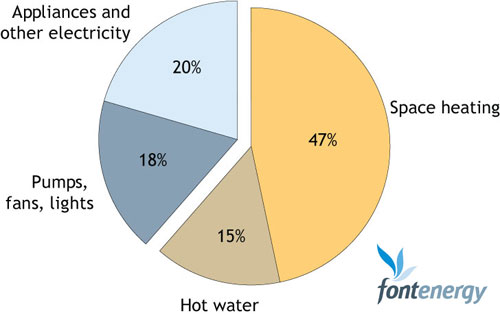
The pie chart above shows that of the emissions from houses in 2050, almost 2/3 will come from heat. Electricity, on the other hand, will only make up just over a third of emissions. Without radical action to decarbonise heat, we won’t get anywhere near the 2050 target.
-
Join 1,209 other subscribers
categories
Recent Comments
Why Ofgem must stick… on how many old homes will get he… Marko Cosic on Testing, testing Martin Winlow on the myth of stone walls as… Martin Winlow on the myth of stone walls as… Martin Winlow on the myth of stone walls as… AlanDHill@hotmail.co… on the myth of stone walls as… Comment: What would… on why we’ll share Open… Top Posts
archive
- May 2024
- January 2019
- August 2018
- October 2017
- July 2017
- March 2017
- January 2017
- November 2016
- October 2016
- September 2016
- July 2016
- May 2016
- April 2016
- March 2016
- February 2016
- January 2016
- October 2015
- August 2015
- June 2015
- April 2015
- March 2015
- January 2015
- December 2014
- November 2014
- October 2014
- September 2014
- June 2014
- May 2014
- April 2014
- March 2014
- January 2014
- December 2013
- November 2013
- October 2013
- February 2013
- January 2013
- July 2012
- June 2012
- May 2012
- April 2012
- March 2012
- June 2011
- January 2011
- October 2010
- August 2010
- June 2010
- April 2010
- March 2010
- February 2010
- January 2010
- October 2009
- September 2009
- August 2009
- July 2009
- June 2009
- May 2009
- April 2009
- March 2009
- February 2009
- January 2009
- December 2008
- November 2008
- October 2008
- September 2008
- August 2008
- July 2008
- June 2008
- May 2008
- April 2008
- March 2008
- February 2008
- January 2008
- November 2007
- October 2007
- September 2007
- August 2007
- July 2007
- June 2007
- May 2007
- April 2007
- March 2007
- February 2007
- January 2007


 carbon limited