Feeds:
Posts
Comments

The quango cull was announced today. Quick headlines:

HCA – “Retain and substantially reform – smaller enabling and investment body working for local communities. Intend to devolve London functions to Mayor of London. Taking on regulation of social housing.”

Renewables Advisory Board – abolished

Sustainable Development Commission– under consideration

Committee on Climate Change – retained

Where the heck is is Energy Saving Trust?


Infuriatingly, it looks like the government may mothball the Environmental Performance Standard, which would have limited emissions from new large power stations. This is despite the fact that both the Conservatives and Libdems championed the policy while in opposition.

As a result it’s likely that emissions from grid electricity will stay high for quite some time. In fact the official line is that the carbon intensity of the grid will remain roughly steady until 2015, when it will plummet towards near-zero carbon in 2040. (As an aside, is it a coincidence that the dropoff comes in 2015, given that it’s the latest possible date for the next general election?) It will be interesting to see how that drop off moves in coming years.

The announcement strongly reinforces the message from DECC that decarbonisation of heat will not be achieved through electrification. In other words, heat pumps are not the answer to decarbonising heat at the national scale.

Source is table 1 from the recently published DECC stats.

help wanted

I’ve just sent this out to recruitment agents. If this is you (or someone your know who’s looking) drop me an email.

Job title: Energy consultant / project engineer

Timescale: Immediate start


Job specification

  • Work alongside our director in the London office to drive forward our ESCO, consultancy, and containerised plant room businesses
  • Carry out options appraisals; provide strategic energy advice to clients
  • Carry out technical modelling of distributed energy systems; refining and owning the spreadsheet tools required
  • Provide input into financial modelling, quickly learning business aspects of energy systems
  • Carry out or oversee mechanical design of energy centres, district heating, and other elements, working alongside our UK team as well as our Danish partners and adopting best practice
  • Help manage the procurement and installation of low carbon plant and infrastructure

Continue Reading »

It’s been a while. Loads has been happening at work – all extremely positive – and it’s been difficult to carve out any time to blog.

Anyway, as part of all this, we’ve moved to new offices. And not just to any old offices, to probably the best offices on planet earth – on Stoney Street in the heart of Borough Market. Most importantly, above the finest coffee in London (Monmouth). Continue Reading »

It’s taken longer than I’d hoped, but here we go:

Continue Reading »

mind the elephant

Just got to the end of the leaders’ debate on ITV and there were exactly zero questions about energy, carbon, and the environment. WTF?

I’ll be in the kitchen drinking sherry and crying if anybody needs me.

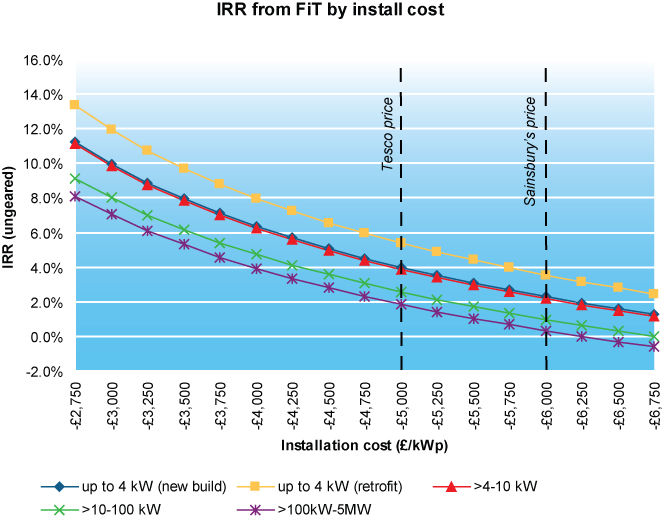
The feed in tariff has arrived and my inbox is filling up fast with emails from companies selling PV systems making wild claims about payback periods and rates of return. Some of them are clearly from cowboys. Some of them are from reputable companies that (unless I’ve missed something or they’re temporarily insane) should know better. In this febrile flurry of market positioning,  PV may rapidly become the new double glazing.

I have to admit that I love PV. As soon as I got to know PV properly through some projects we’re doing in Italy, I fell in love.  PV is the business and I have absolutely no doubt that it’s a key solution to our long term energy needs.

But you’ve got to be realistic about costs and output. The UK isn’t Italy. As a result of years of domination by very few players, the UK PV market remains immature and install costs are high. In addition, (obviously) there’s less solar radiation so outputs are lower.

So what sort of IRR is realistic? I’ll go do some graphs now.

In the UK we generate enough heat each year to meet the needs of every home in the country… and then we throw the heat away. So why should we promote the use of precious resources and expensive technologies to generate that heat a second time?

Continue Reading »

The proper way to slash carbon emissions is to tax carbon at the point of fuel extraction and let the market sort the problem out.

But because there’s no political appetite for carbon tax, we end up tinkering at the margins trying to address the emissions problem in tortuous and esoteric ways. Here’s a list I jotted down on the train on my way into the office:

  • CERT
  • SHESP
  • CESP
  • PAYS
  • Decent Homes
  • Allowable Solutions
  • Part L
  • RHI
  • FiT
  • CCL
  • CRC
  • ROCs
  • Retrofit for the Future
  • JESSICA, JASPERS, ELENA
  • Expanded Suppliers Obligation

All of this cost and bureaucracy becomes redundant the moment the real price of carbon is reflected in the cost of energy. Is political expediency the biggest obstacle to carbon abatement?

Design a site like this with WordPress.com
Get started